

Remembering Peace in a Time of War: Why International Law Matters More Than Ever | Manufacturing Peace
The Right to Peace:
From Proclamation to Human Right
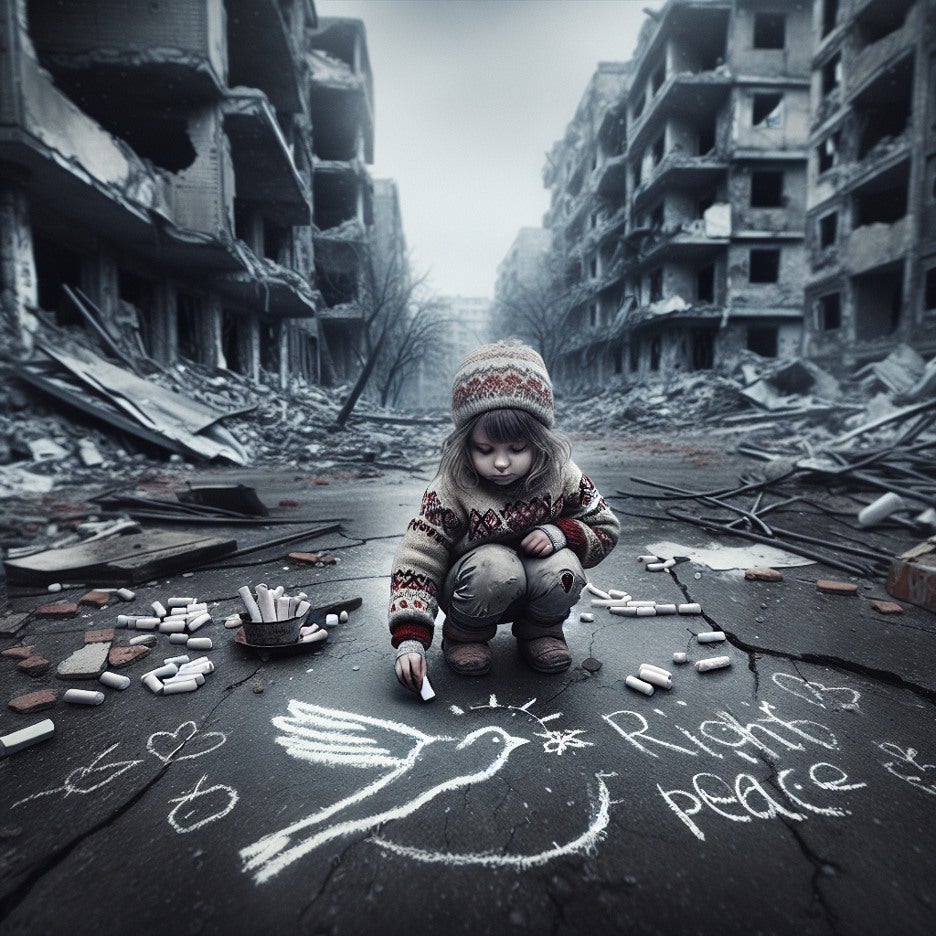
It isn’t enough to talk about peace.
One must believe in it.
And it isn’t enough to believe in it.
One must work at it.
Eleanor Roosevelt
Do we have a human right to peace?
The right to peace has been recognised as individual and collective human right in numerous international documents of varying normative status, including the Declaration on the Preparation of Societies for Life in Peace (1978), the Declaration on the Right of Peoples to Peace (1984), and the Declaration on the Right to Peace (2017). On regional level, a collective right of people to national and international peace has been incorporated in the African Charter on Human and Peoples’ Rights (1981, art. 23) and the Protocol to the African Charter on Human and Peoples’ Rights on the Rights of Women in Africa (2003, art. 10) as well as the individual and collective right to enjoy peace is acknowledged in the ASEAN Human Rights Declaration (2012, art. 38). Though Arab, Inter-American, and European Human Rights Systems emphasise the close link between international peace and human rights, they have not yet explicitly recognised the right to peace (see the Arab Charter on Human Rights (2004), the Charter of the Organisation of American States (1948), the European Convention on Human Rights (1950)). Provisions relating to the right to peace have been included in constitutions of several states (see the constitutions of Japan, Congo, Ecuador, Colombia, Bolivia).
However, at present, the ‘sacred right to peace’ (Declaration on the Right of Peoples to Peace, para. 1) is among the least specified and the most ignored human rights. Neither in legal theory nor in international practice is there a consensus regarding its nature, status, content, and scope, territorial and extraterritorial obligations deriving from, and corresponding to, the right, as well as relevant duty-bearers. Acknowledged predominantly by soft law instruments, the right to peace is being frequently interpreted as a proclamation rather than a legal entitlement (see here), i.e., as non-claimable, non-enforceable, and non-justiciable ‘manifesto’ right. Over 120 armed conflicts currently taking place worldwide (see here) give us a lot of evidence of how the right to peace is violated by states and non-state actors alike. The dominating state-centric approach to the right to peace excludes non-state actors from being duty-bearers (cf. Declaration on the Right to Peace, art. 3). Except for the African Human Rights System and legal orders of some states recognising the right to peace, states cannot be held accountable for violations of the right.
Why peace should be the object of a human right?
The Declaration on the Right to Peace recalls that ‘the promotion of the right to peace […] [is] a vital requirement for the full enjoyment of all human rights for all’ (Preamble). The International Bill of Human Rights stresses a foundational role of human rights for the enjoyment of peace (see Preambles here, here, here). It has been widely accepted that war is incompatible with the (full) realisation of human rights and is itself a violation of multiple human rights (see here, here, here).
In this context, why it is essential to establish peace as the object of a distinct human right? Are the existing international law guarantees of peace as one of the four pillars of the United Nations—i.e., provisions for peace in the UN Charter (1945), including the requirement to settle international disputes by peaceful means and the prohibition of the threat or use of force (art. 2(3&4))—along with the annunciation of the close interdependence between peace and human rights not enough? What is an added value of guaranteeing the human right to peace?
As legitimate entitlements that individuals and people have against relevant others, human rights have several important characteristics: ‘they are (1) universal, (2) high-priority entitlements, that (3) call for legal recognition, (4) give rise to corresponding obligations of certain actors, and (5) are grounds for taking international actions against those actors’ (see here). As Joseph Raz persuasively showed, not only an object of a right (i.e., peace), but also the very possession of the right (which means enjoying secure access to its object) are of value to right-holders (see here). Thus, human rights are entitlements claimable against relevant duty-bearers and giving right-holders a stronger level of control over the behaviour of duty-bearers and the object of the right (Leon Petrazycki, Law and Morality (2011) 47). Moreover, in accordance with art. 28 of the Universal Declaration of Human Rights, human rights give rise to institutional obligations to create and maintain an institutional order indispensable for their implementation, enforceability, and justiciability. According to Baroness Onora O’Neill, specified, allocated, claimable, and enforceable rights-based obligations distinguish genuine human rights from ‘manifesto’ or ‘empty’ rights (see here).
How the right to peace could be transformed from proclamation to human right?
On this premise, transforming the right to peace from proclamation, or ‘manifesto’ right, to a human right would include several interrelated measures:
(1) A more explicit global recognition of the right to peace as a universal, high-priority, claimable legal entitlement of all people and every individual regardless of the territory in which they reside. This would imply creating a normative framework clarifying the nature, status, content, and scope of the right to peace, including a legally binding international treaty on the right. Considering an exceptional value of its object, the ‘sacred right to peace’ has a potential to be acknowledged as an absolute (non-derogable) human right. Importantly, a human rights-based approach to peace is not limited by a thin (negative) definition of peace as a mere absence of war but rather proceeds from a thick (positive) interpretation of peace in which ‘all human rights are promoted and protected and development is fully realised’. In this respect, guarantees of justice, equality, non-discrimination, the rule of law, freedom from fear and want are ‘means to build peace within and between societies’ (Declaration on the Right to Peace, Preamble, arts. 1-2).
(2) Determining and assigning to concrete actors obligations corresponding to the human right to peace. The UN Charter, international human rights instruments, and documents addressing the implementation of the right to peace (see here, here, here) provide an important normative basis for this endeavour. According to the tripartite theory, obligations derived from the right to peace would embrace: (a) obligations to respect, including obligations to refrain from aggressive war and unlawful threat or use of force, to settle disputes peacefully, and to refrain from contributing to, or assisting in maintaining, military conflicts and supporting the aggressor; (b) obligations to protect, including obligations to avert the risks of war and strengthen international peace, to (use every appropriate tool to) stop the aggressor and seek an end to the war, to protect war victims (including refugees, asylum seekers, and displaced persons), and to hold the aggressor and all perpetrators to account and ensure justice for victims; and (c) obligations to fulfil, including obligations to promote and facilitate peace (i.e., to achieve general and complete disarmament and use resources for peaceful development, to advance a culture of peace, and to ensure access to educational programs, knowledge, and information on the right to peace), as well as obligations of cooperation and assistance for peace. It is also important to acknowledge that not only states but all members of the international community, including non-state actors and individuals, are bound by individual and shared obligations derived from the right to peace. The question on how these obligations should be fairly distributed among various duty-bearers and what sacrifice one might legitimately expect from them requires special consideration.
(3) Undertaking institutional arrangements necessary for the realisation and enforcement of the human right to peace on global, regional, and national levels. This would presuppose: (a) employing all existing mechanisms for building and maintaining peace to secure the enjoyment of the human right to peace; (b) creating a new just and sustainable institutional structure ensuring meaningful and full-fledged participation of individuals, social groups, and peoples, especially the most vulnerable, in all decision-making, norm-setting, and institution-designing processes that concern the right to peace; and (c) developing monitoring and accountability bodies, especially individual complaint mechanisms, at international and regional levels to provide effective and affordable remedies for violations of the right to peace.
Referring to the timeless words by Eleanor Roosevelt taken as an epigraph, it is not enough to talk about, or believe in, peace—we ‘must work at it’. Some important urgent steps to advance the right to peace as a human right should encompass the elaboration of a normative framework, including a legally binding international treaty, clarifying its nature, status, content, and scope as a universal, high-priority, claimable legal entitlement, the specification of obligations corresponding to the right and allocation them to various global actors, as well as the creation and maintenance of a just and sustainable institutional structure indispensable for the implementation, enforceability, and justiciability of the right to peace.