
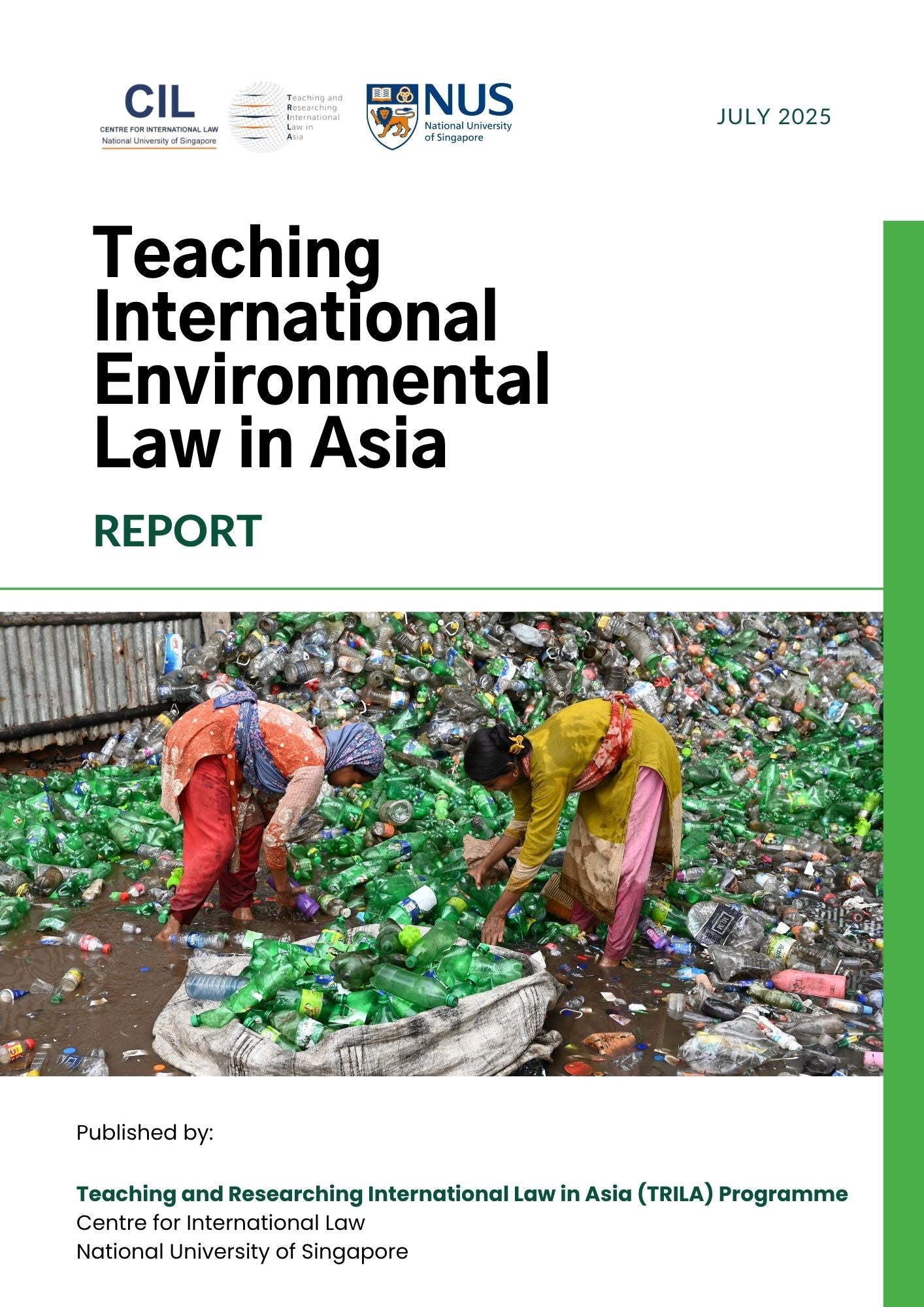
Teaching International Environmental Law in Asia Report 2025
Rapporteurs and Editors (TRILA Team):
Prof Antony Anghie
Mr Amiel Ian Valdez
Mr Brandon New Jun Jie
Published online on 15 July 2025
The Teaching and Researching International Law in Asia (TRILA) programme at NUS Centre for International Law (CIL) is pleased to present the Teaching International Environmental Law in Asia (TRILA IEL) Report 2025.
This report captures the insights and recommendations that emerged from a three-part webinar series held in February 2025, which brough together leading academics and practitioners from across Asia and the Pacific. The webinars explored how International Environmental Law (IEL) is taught in the region, the unique challenges faced by educators, and opportunities to develop more regionally relevant and innovative approaches.
Key topics discussed include:
- Evolution of Teaching International Environmental Law in Asia: How the teaching of IEL has evolved, challenges in the classroom, and ways to integrate Asian perspectives and experiences into the curriculum.
- Developing Syllabi and Teaching Resources: Practical guidance on selecting course topics, using local materials, and applying diverse methodologies to improve student engagement and critical thinking.
- Looking Ahead: Future directions for IEL teaching and research in Asia, including how environmental law intersects with climate change, sustainability, human rights, trade, and emerging technologies.
The report highlights the collaborative spirit of TRILA’s growing community and offers practical suggestions for academics, institutions, and policymakers interested in strengthening environmental legal education in Asia.
Speakers included experts from Australia, Fiji, Indonesia, Malaysia, the Philippines, Singapore, Thailand, Vietnam, and other countries. Their contributions reflect the diversity of experiences and approaches that enrich the field of International Environmental Law across Asia. The event was attended by more than 100 participants from different parts of Asia and beyond. The participants’ questions and comments, which are also included in this report, have certainly enriched the discussions.
We hope this report will serve as a valuable resource for educators and researchers working to equip the next generation of environmental lawyers and policymakers.