
CIL Regional Forum on Legal Considerations for ASEAN Power Grid & Subsea Interconnectors
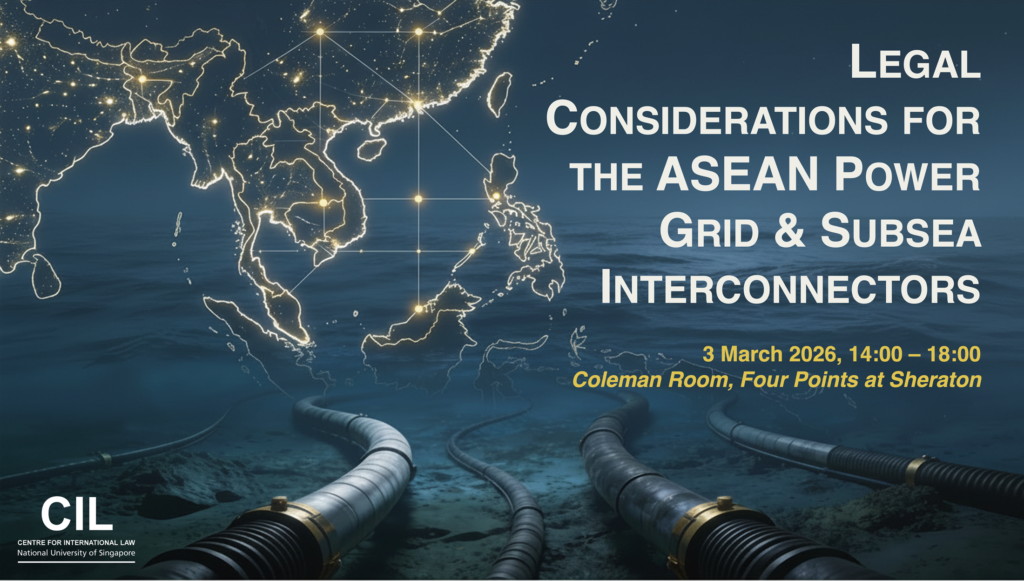 On 3 March 2026, the Centre for International Law (CIL) Energy Law & Policy and Ocean Law & Policy teams co-organised the CIL Regional Forum on Legal Considerations for ASEAN Power Grid & Subsea Interconnectors. This event brought together a diverse range of stakeholders from the region including government officials, policymakers, practitioners, and industry leaders. This half-day event comprised an opening segment and two sessions.
The forum began with CIL Director, Dr Nilufer Oral providing her welcome remarks. Following this, Dr Peerapat Vithayasrichareon (International Energy Agency) and Mr Jonathan Goh (Energy Market Authority, Singapore) provided their opening remarks, setting the scene for the discussions that followed.
The focus of first session was on the international law governing submarine power cables activities, particularly under the United Nations Convention on the Law of the Sea (UNCLOS) and consider the specific context for Southeast Asia. Co-heads of Ocean Law and Policy Dr Tara Davenport and Prof. Robert Beckman and Mr Matthew Wittenstein (United Nations Economic and Social Commission for Asia and the Pacific (UNESCAP)) were speakers for this session.
The focus of the second session was on comparative regional/sub-regional experiences in advancing cross-border power connectivity through submarine power cables. Prof. Catherine Banet (University of Oslo), Ms Georgie Skipper (Lucetia Group), Mr Shamim Razavi (Norton Rose Fullbright) and Mr Matthew Wittenstein (UNESCAP) were speakers for this session.
Head of Energy Law and Policy Ms Denise Cheong and Research Fellow Ms Nivedita S were Co-Chairs of the forum.
Pre-Event Information
By-Invitation-Only Event
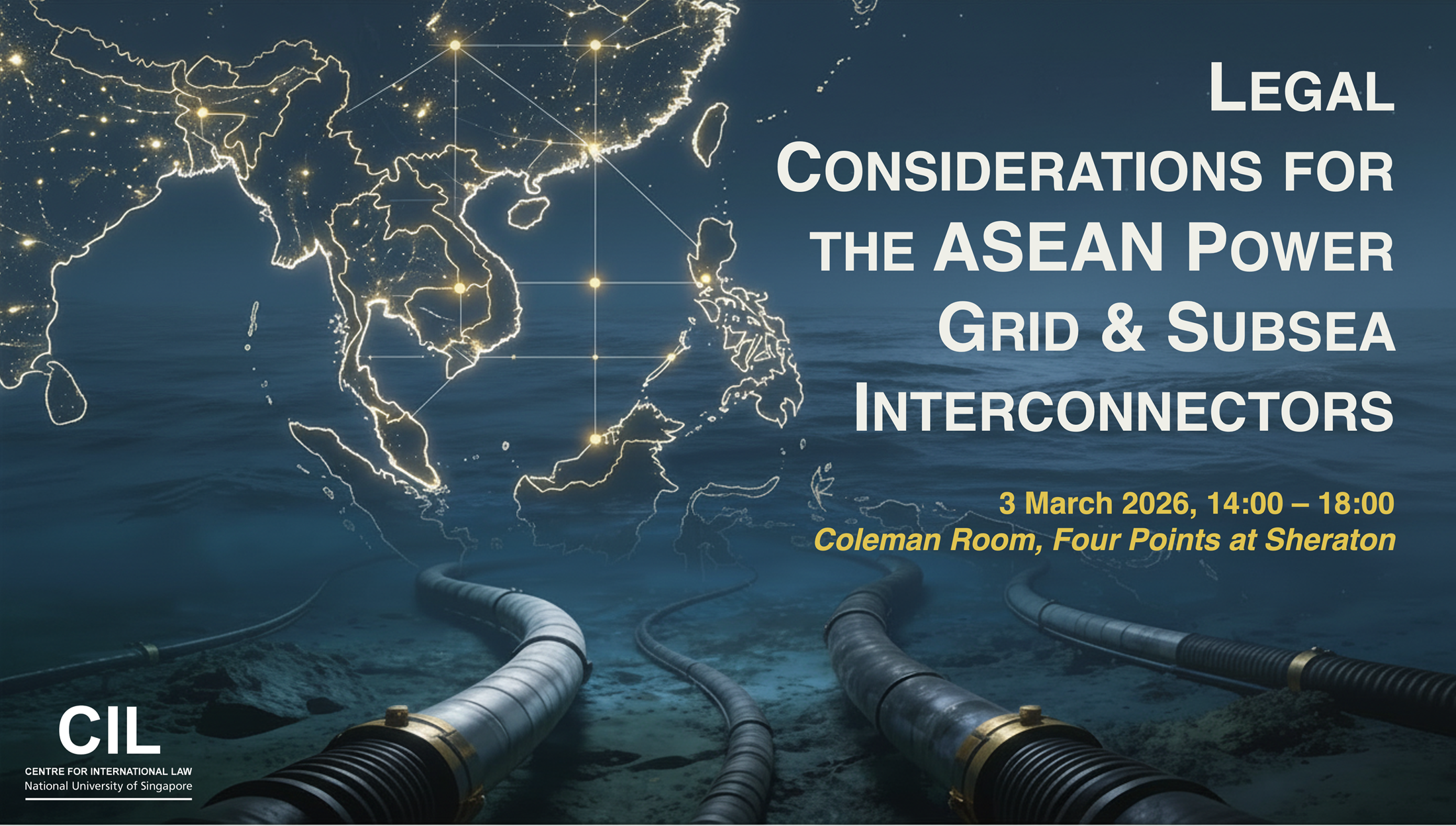
A key initiative under the ASEAN Plan of Action for Energy Cooperation (APAEC) 2016–2025, and the newly endorsed APAEC 2026–2030, is the development of the ASEAN Power Grid (APG). The APG serves as a cornerstone of ASEAN's energy transition strategy, offering a pathway for regional energy solidarity, sustainability and security through integration of renewable and low-carbon sources.
Progress on the APG, which has been advancing for decades, has gathered renewed momentum through various regional initiatives and efforts—including, but not limited to, the LTMS-PIP pathfinder project and Malaysia’s 2025 ASEAN Chairmanship. At the 43rd ASEAN Ministers on Energy Meeting (AMEM) in October 2025, ASEAN signed the Enhanced Memorandum of Understanding (MoU) on the APG, adopted Terms of Reference (ToR) for APG Bodies, and endorsed the ToR for the ASEAN Subsea Power Cable Development Framework. This framework highlights four enablers for submarine power cables—(i) legal and regulatory, (ii) technical, (iii) commercial, and (iv) governance—marking milestones toward APG implementation by 2045.
The development of the APG encompasses infrastructure development, transmission, distribution, and power trading, with transmission infrastructure central to grid operationalization. Against this background, this regional forum will initiate dedicated discussion on legal considerations for subsea transmission infrastructure and examine the international legal framework as well as relevant case studies to identify insights for APG governance.
Email cil.events@nus.edu.sg / cil.energy@nus.edu.sg / chaudo@nus.edu.sg for enquiries.