
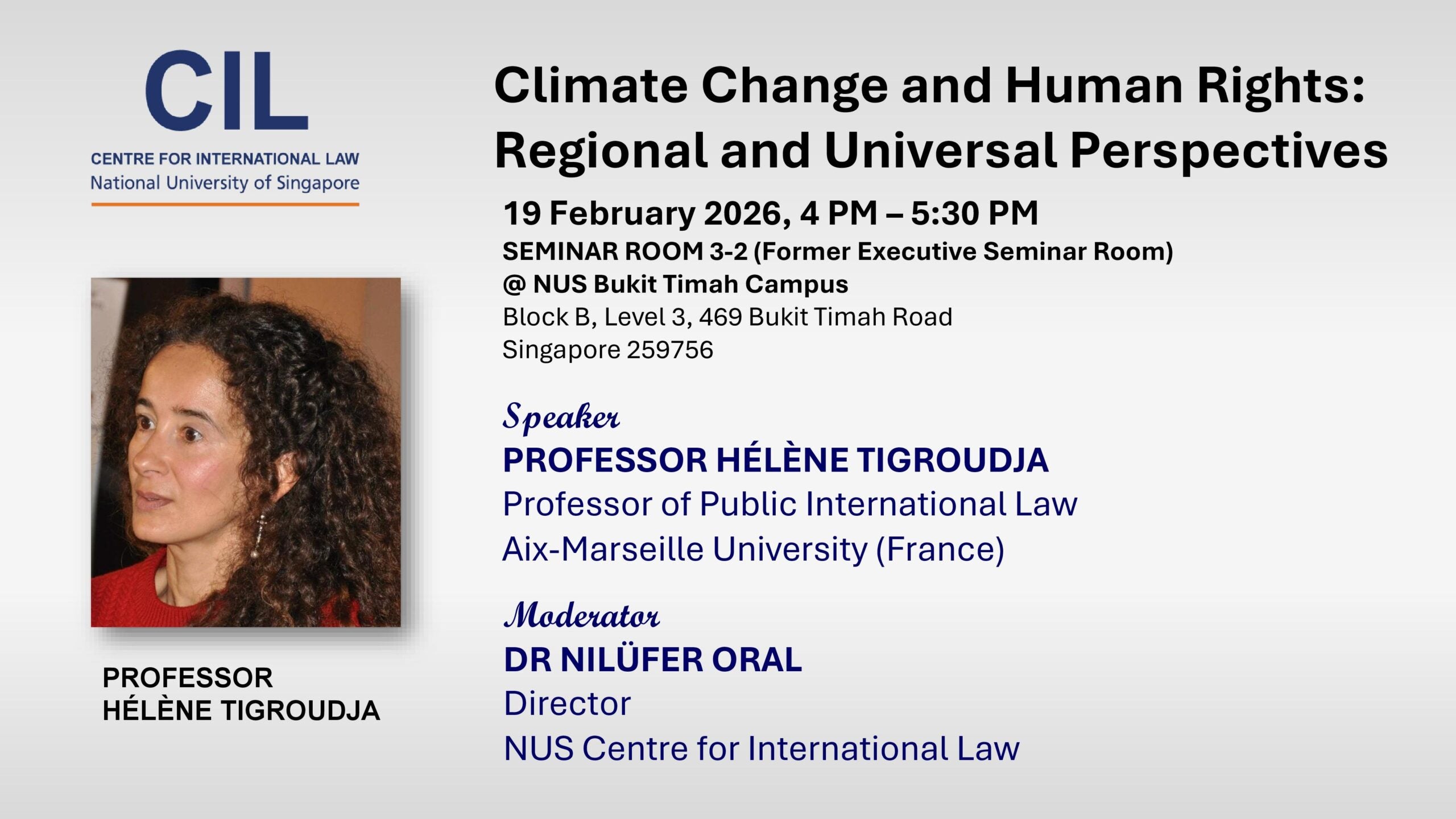
INTRODUCTION In its Advisory Opinion No. 32 (AO32), the Inter-American Court of Human Rights called for the application of the pro actione principle « with respect to the admissibility of actions, appeals filed, and requirements regarding the stand » (para. 546). Therefore, the question must be raised whether these conditions for lodging a complaint before the regional or the universal bodies should be shaped by the object of the action and the context of climate emergency in which this action is made. The Lecture will explore not only what the application of the pro actione would mean for the interpretation of the exhaustion of domestic or the victimhood conditions, but also what it would mean under a broader human rights perspective. Is it acceptable to create exceptions to the exhaustion rule, or to the locus standi - which reflects the individualistic and subjective nature of human rights protected from 1948 -? If so, this procedural exceptionalism justified by the “polycrisis” (AO32, para. 206) is perfectly understandable. However, it would also inevitably raise the debate about the extension of such a procedural exceptionalism to the protection of other values and interests (protection of democracy and civic space, defence of core human rights such as the right to dignity or integrity, prohibition of discrimination), the protection of specific peoples and groups placed in situation of vulnerability (children’s rights for instance) or the protection of rights during specific contexts (armed conflicts, emergency situations).
ABOUT THE SPEAKER Hélène Tigroudja is Professor of Public International Law at Aix-Marseille University (France) and she has been serving as a member of the United Nations Human Rights Committee since 2019. She has been re-elected to serve a second term until 2026. She has been appointed as Special Rapporteur on New Communications and Interim Measures. Hélène was a Hauser Global Professor at NYU (2021-2023) and is a Visiting Professor at the Graduate Institute of Internationale Affairs and Development in Geneva and at the Geneva Academy of Human rights and humanitarian law (2024-2025). She has published extensively on various topics dealing with human rights and international law. She recently co-authored the Commentary of the American Convention on Human Rights (OUP, 2022) and a Treatise of International Human Rights Law (forthcoming, Cambridge University Press).
In 2023, she gave a course at The Hague Academy of International Law on “Armed Conflicts and Human Rights” that will be published in the Collected Courses of The Hague Academy of International Law (forthcoming, Brill). Since 2002, she has acted regularly as an expert for the Council of Europe; UNESCO, and the European Union. Her focus in teaching and research ranges from international law, European law, international human rights law, international criminal law, and international migration law, with special focus on comparative approaches of universal and regional human rights mechanisms; remedies; States’ and International Organisations’ immunities; and the application of human rights in context of armed conflicts and situations of occupation.
ABOUT THE MODERATOR Nilufer Oral is Director of the Centre of International Law at the National University of Singapore. She is a member of the UN International Law Commission (ILC) and served as Co-chairperson of the 74th session w. She is also a Co-chair of the ILC Study Group on sea-level rise in relation to international law. In addition, she is a member The Hague Academy of International Law Curatorium and an associate member of the Institut de Droit International. She was a legal advisor and climate change negotiator for Turkish MFA (2009-2016). She is currently a Member of the Committee of Legal Experts of the Commission of Small Island States on Climate Change and International Law (COSIS). She is a Distinguished Fellow of the Law of the Sea Institute at Berkeley Law and a Senior Fellow of the National University of Singapore Law School.
She has appeared before ITLOS and the ICJ for advisory proceedings.
Dr. Oral served on the International Union for Conservation of Nature (IUCN) Council (2012-2016); was Co-chair of the IUCN Specialist Group on Oceans, Coasts and Coral Reefs (2006-2018); and Chair of the IUCN Academy of Environmental Law (2014-2017).
Dr. Oral is the series editor for the International Straits of the World publications (Brill); she is also on the editorial board of different publications including as member of the Board of Editors of the European Society of International Law Series; Associate Editor of the Research Perspectives in the Law of the Sea (Brill). She has published numerous articles and edited several books, and has spoken at numerous international conferences.
REGISTRATION
"*" indicates required fields