
Click here for Episode 1
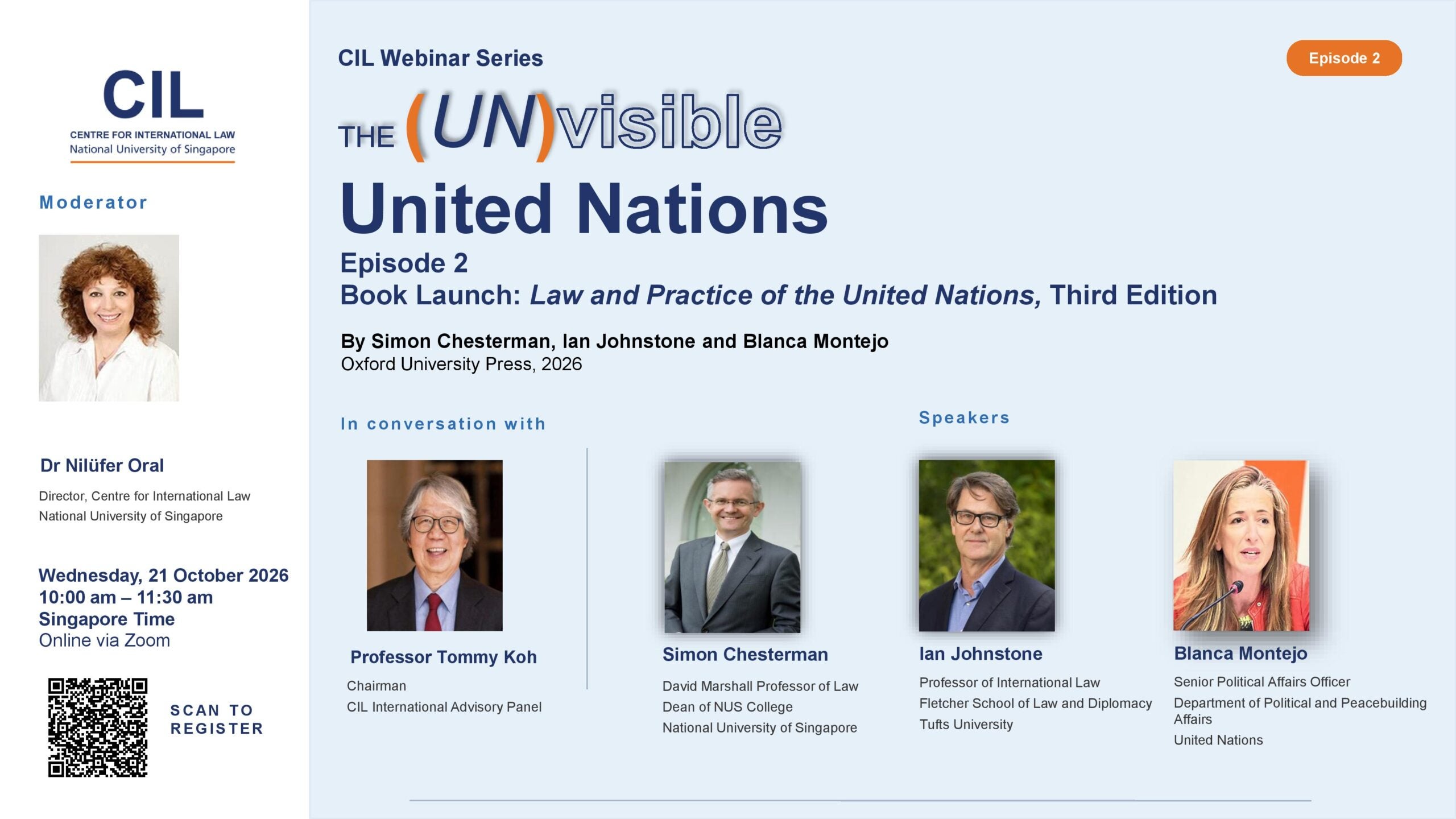
The (UN)visible United Nations is a CIL webinar series examining what the United Nations actually does, behind the scenes, to keep international law and multilateral cooperation moving.
For eighty years, the United Nations has helped develop, codify, interpret and sustain international law, while supporting multilateral cooperation through successive periods of upheaval and uncertainty. Much of this work happens away from the headlines: in committees and commissions, peace operations and fact-finding missions, training programmes and regional offices, and through the people who keep these institutions working.
The second episode is a book launch of the third edition of very popular The Law and Practice of the United Nations by Simon Chesterman, Ian Johnstone and Blanca Montejo, published by Oxford University Press in 2026.
The book provides the starting point for a broader discussion of the relationship between the law of the United Nations and the practice through which that law is interpreted, applied and developed.
The session will examine what eight decades of United Nations practice reveal about how the Organisation's legal framework operates in practice. It will explore how the UN Charter and other legal frameworks are interpreted and applied by the Organisation's institutions, and how institutional practice, State participation and political context contribute to the continuing development of UN law.
The discussion will consider the roles played by the Security Council, General Assembly, Secretariat and other institutional actors, and the relationship between formal legal rules and the practical realities within which UN institutions operate.
The book launch will also provide an opportunity to reflect on the evolution of UN law and practice over the Organisation's first eighty years and to consider how the accumulated practice of the United Nations informs its capacity to respond to changing international circumstances.
Learning Objectives
At the end of the session, participants should be able to:
-
- Identify the principal legal and institutional frameworks governing the operation of the United Nations and their relationship to subsequent institutional practice.
- Explain how the practice of United Nations organs and institutions contributes to the interpretation, application and development of international law.
- Recognise the interaction between formal legal rules, institutional authority, State participation and political considerations in the operation of the United Nations.
- Analyse how institutional practice may clarify, develop or contest existing understandings of international law.
- Assess the significance of institutional practice for the coherence, adaptability and continuing development of the UN legal order.
- Apply an understanding of UN law and practice to contemporary questions concerning the functioning, adaptation and reform of the United Nations
Speakers and Moderator
Professor Tommy Koh | Professor Emeritus, National University of Singapore, Centre for International Law; Former Ambassador-at-Large, Ministry of Foreign Affairs, Singapore; former Permanent Representative of Singapore to the United Nations; former President of the Third United Nations Conference on the Law of the Sea.
Simon Chesterman | Dean and Provost's Chair Professor of International Law, National University of Singapore; author of The Law and Practice of the United Nations, 3rd edition.
Blanca Montejo | Co-author, The Law and Practice of the United Nations, 3rd edition; United Nations.
Ian Johnstone | Co-author, The Law and Practice of the United Nations, 3rd edition; Tufts University.
Dr Nilüfer Oral (Moderator) | Director, Centre for International Law, National University of Singapore and Member, United Nations International Law Commission.
 1.5 Public CPD Points
Practice Area: International Law
Training Category: General
Participants who wish to obtain CPD Points are reminded that they must comply strictly with the Attendance Policy set out in the CPD Guidelines. For this activity, this includes logging in at the start of the webinar and logging out at the conclusion of the webinar in the manner required by the organiser, and not being away from the entire activity for more than 15 minutes. Participants who do not comply with the Attendance Policy will not be able to obtain CPD Points for attending the activity. Please refer to http://www.sileCPDcentre.sg for more information.