

Remembering Peace in a Time of War: Why International Law Matters More Than Ever | Manufacturing Peace
Asia’s Peace-Conflict Continuum
by Rashmi Raman & Samuel White
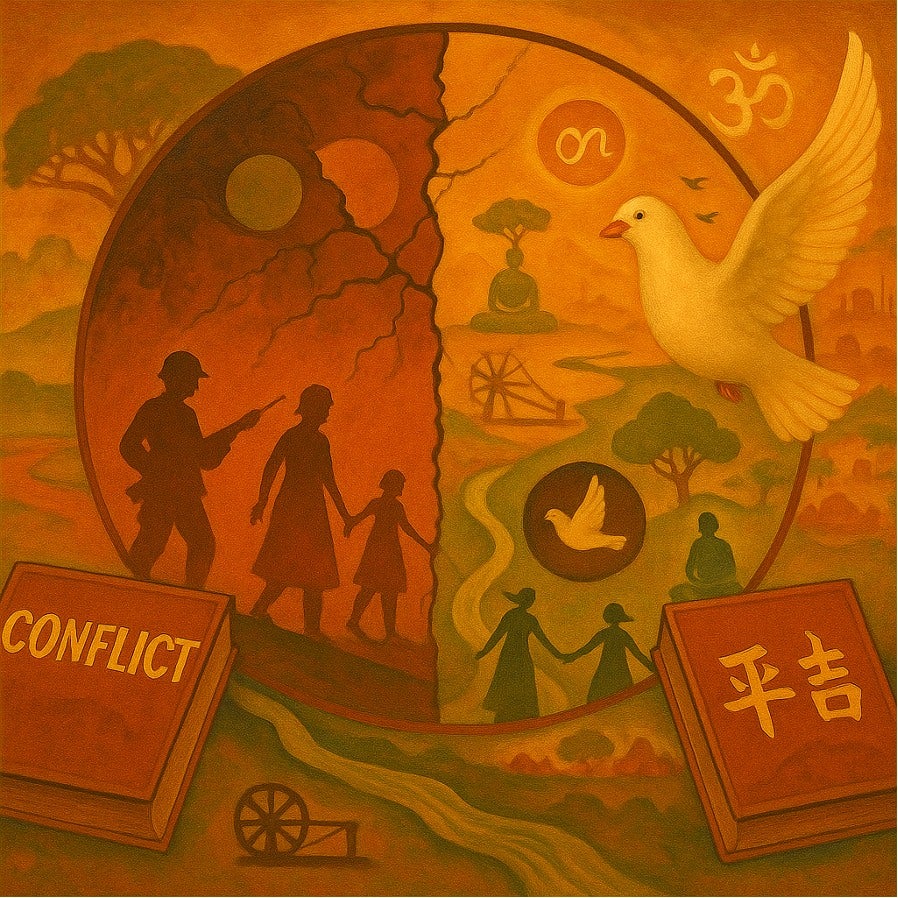
International law is framed in a binary construct: peace, and conflict. Although the primary position of international law is to promote peace, the concept is fragile. There is risk that peace also centres conflict (see, for example, the work of Samuel Moyn on this). Where there is much written and discussed about conflict and the abeyance of the international rule of law, we want to move the focus away from the all-consuming mechanisms, vocabulary and institutions of international law that have war and conflict as their foundation. Instead, we focus on peace, offering case studies from Asia. Asia offers a rich source of the absolutely essential vocabulary of peace as a basis for “thickening” the international rule of law that informs, animates and protects states, from each other and from themselves, in the current landscape of the attack on international law and its institutions, actors and agents.
Asian approaches
It is evident that different cultures understand peace and conflict through different lenses. Law, in turn, reflects these cultural understandings. In conflict, Asian traditions (and we use the term in a broad sense) tend to prioritise diplomacy, de-escalation, and the maintenance of social order. Perhaps arising from the legal framework of the Middle Kingdom, Confucianism’s emphasis on harmony and the role of benevolent rulers can influence the preference for avoiding conflict, emphasising moral leadership and mutual respect in resolving disputes. Conflict, from this perspective, is often viewed as a failure of governance and a disruption of social order, rather than a legitimate or necessary tool of statecraft (think here of Clausewitz’s infamous definition of war as ‘the continuation of politics by other means’). So too do Indian perspectives differ from Western counterparts. Rooted in ancient texts such as the Mahabharata, Bhagavad Gita, and Upanishads, Indian thought often explores the moral, ethical, and spiritual dimensions of conflict. In the Bhagavad Gita, for instance, war is portrayed not just as a physical battle but as a spiritual struggle between good and evil, duty and personal desires. The concept of dharma (righteous duty) plays a central role, suggesting that peace is not merely the absence of war but a deep alignment with moral principles that transcend the duality of war and peace. The idea of dharma is similar to the Malay concept of adat, which regulated all aspects of life (including conflict) across the peninsula and Borneo.
Buddhism, which has a strong presence across Asia, advocates for non-violence (ahimsa) and mindfulness, promoting peace as an internal and external condition. Buddhist thought encourages reconciliation and compassion, suggesting that enduring peace requires not just the cessation of violence but the transformation of negative emotions, such as hatred and greed, that fuel conflict (for an exciting space where international criminal law and Buddhism met, see here). Of course, there are differing perspectives within the Buddhist tradition and its interrelation with conflict, of which the International Committee of the Red Cross have expertly compiled). In Asian legal thought, peace is seen as more continuous and dynamic—an ongoing process of inner tranquility and societal harmony.
On the other hand, some Asian perspectives, particularly in more authoritarian contexts, have been critiqued for prioritising stability over individual rights and freedoms, potentially justifying the suppression of dissent or the use of force to maintain peace. The idea of ‘order before liberty’ in some Asian political systems can lead to a more pragmatic view of peace, where the stability of the state or community may be considered more important than individual freedoms. In this sense, the approach to peace might appear more flexible or even more utilitarian, focused on avoiding disruption rather than promoting individual rights.
India’s Gandhian approach to peace draws deeply from Indian philosophical traditions, particularly Jainism and Buddhism, which place ahimsa (non-violence) at the centre of ethical life. These traditions challenge the legitimacy of war as a means of resolving conflict, instead promoting peaceful coexistence and the minimisation of harm in all its forms. Conflict, from this perspective, is best addressed through dialogue, compassion, and non-violent action. While Indian thought does acknowledge that war may be an unfortunate necessity in the defence of righteousness or justice, a notion that resonates with just war theory, it is always tempered by profound ethical reflection. Peace is thus envisioned not merely as the absence of violence, but as an active, ethical state that intertwines inner tranquillity, social harmony, and collective moral responsibility. This vision offers a more expansive and integrated sketch of “just peace”.
By contrast, the European and Western tradition, particularly as shaped by the just war theory from Aquinas to Martin Luther King Jr., tends to frame peace and war in binary terms. This tradition has nonetheless contributed significantly to modern international law, informing doctrines such as self-defence and the Responsibility to Protect (R2P), and to transitional justice, through its focus on mercy, reconciliation, and forgiveness. Yet where Western frameworks often emphasise the legality and limits of war, many Asian traditions present a non-dualistic understanding of peace and conflict, grounded in relational ethics and the avoidance of confrontation. These traditions favour community-based, dialogic approaches to conflict resolution, emphasising sustained peace not only as a political outcome but as an ethical and spiritual process.
In many Asian traditions, peace is not merely the absence of war but a dynamic state of balance, harmony, and mutual respect. Confucianism, for example, promotes the idea of ren (benevolence) and li (ritual propriety), encouraging individuals and states to maintain harmonious relationships through moral behaviour and respect for social roles. In Buddhist cultures, peace is seen as an internal and external process of overcoming suffering, emphasising non-violence, mindfulness, and interconnectedness. Despite (or maybe because of) their difficult relationship with colonialism and its deep impact on state building in post-colonial Asia, many Asian societies value indirect methods of diplomacy and consensus-building over confrontation, often preferring negotiations, mediation, and long-term relationship-building over quick resolutions.
This contrasts with the European model, which has historically been rooted in a more defined dichotomy of war and peace, where the end of one conflict often leads to a rigid return to peace, sometimes with little attention to the deeper causes of unrest or the complexities of sustaining a long-term peace outcome. Asian approaches to humanitarian law and human rights law reflect this model of treating processes of international law with suspicion and relegating them to exceptionalism. This sense of exceptionalism, marked by under-participation and under-representation, can be traced back to the formative encounter between East and West during colonialism. That period saw the erosion of long-standing princely and independent states across Asia, many of which predate today’s sovereign states. Furthermore, the core institutions of modern international law were established in the aftermath of World War II, at a time when most Asian states had little influence and were largely excluded from their creation. As a result, they became passive participants in a legal order they had no role in shaping.
We may also infer this reluctance from the long-standing conflicts in Asia that have been subject to formal processes of adjudication in international law—the Pedra Branca dispute between Singapore and Malaysia and the Temple of Preah Vihear between Cambodia and Thailand, both of these cases at the International Court of Justice involving territorial claims were hailed as exceptional willingness by Asian states to resort to a rules-based, international dispute settlement model within a larger tradition of resorting to negotiation and keeping territorial claims away from international scrutiny. As exceptions that prove the rule, these cases help illustrate toward international law and institutions.
We argue that Asian approaches to peace and conflict present a more fluid, ethically integrated, and culturally embedded understanding of the peace–conflict continuum than the traditional Western legal dichotomy. Rather than framing peace simply as the absence of war, many Asian traditions regard it as a moral and spiritual ideal, sustained through harmony, self-restraint, and the preservation of social order. These approaches often prioritise diplomacy, de-escalation, and relational ethics, seeing conflict as a breakdown in governance or virtue rather than an inevitable or legitimate tool of statecraft. In reframing our understanding of peace through these lenses, international law can be enriched by alternative vocabularies and values—moving beyond binary structures to embrace a more nuanced, culturally diverse foundation for the promotion and maintenance of international order.