

Forced Pregnancy and the Perpetrator’s Theory of Descent: Reproductive Violence and the Limits of Genocidal Intent
By Bhavya Johari
Published on 19 August 2026
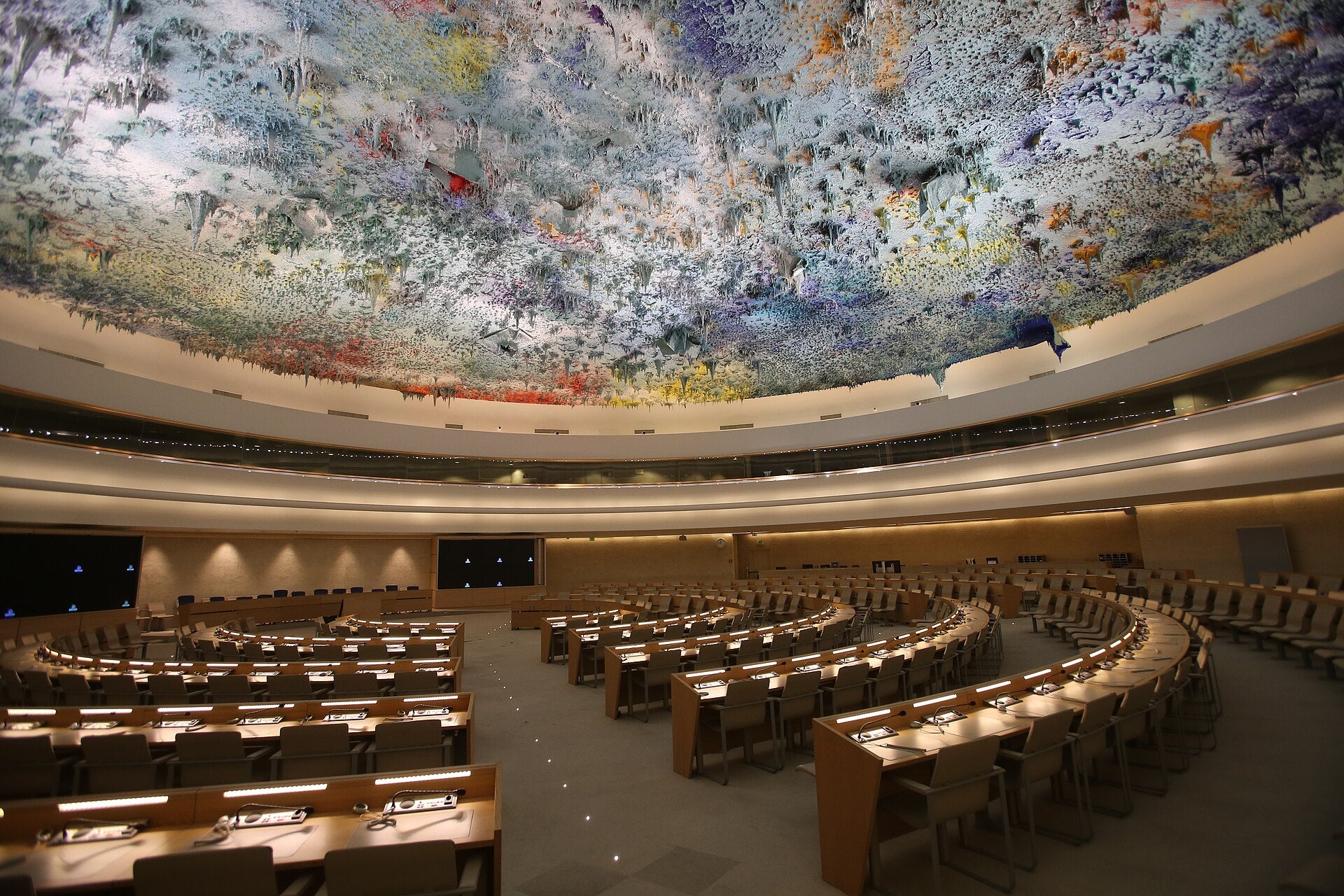
On 7 July 2026, the Human Rights Council (HRC) adopted, as orally revised and without a vote, Resolution 62/18 on women’s and girls’ full enjoyment of human rights in humanitarian situations. Its preamble is the first negotiated United Nations outcome to name reproductive violence as a distinct category of gender-based violence, listing forced contraception or denial of contraception, forced pregnancy, forced abortion, and forced sterilisation, ‘including when undertaken with the intent to destroy a group.’
That phrase invokes the Convention on the Prevention and Punishment of the Crime of Genocide (Genocide Convention), which accommodates three of the four acts without difficulty. Forced sterilisation, forced abortion, and forced contraception each suppress births, and Article II(d) of the Genocide Convention prohibits measures intended to prevent births within a group. Forced pregnancy has the opposite effect. It remains capable of engaging Article II(b), which concerns serious bodily and mental harm and locates the wrong in the injury to the woman. Only Article II(d) treats forced pregnancy as genocidal for what the pregnancy does to the group rather than for what it does to her, and the sole authority extending that provision to forced impregnation is a single passage in Akayesu, the judgment in which the International Criminal Tribunal for Rwanda (ICTR) entered the first conviction for genocide by an international court. That passage makes the characterisation depend upon the perpetrator’s conception of how group membership descends. It is obiter; no court has applied it, the ICTR did not repeat it, and the findings of fact in the same judgment contradict it. The HRC has now restored it to circulation.
This post sets out the condition upon which that passage rests, shows that the same judgment refutes it, and argues that reproductive violence belongs where the International Criminal Court (ICC) has already placed it, in the woman’s reproductive autonomy rather than the composition of the group.
The Akayesu dictum and its refutation
Trial Chamber I in Akayesu construed Article II(b) at paragraph 504 and applied it at paragraph 731, holding that rape and sexual violence constitute the infliction of serious bodily and mental harm. Turning to Article II(d) at paragraph 507, it enumerated sexual mutilation, sterilisation, forced birth control, separation of the sexes and prohibition of marriages, and extended the provision to forced impregnation upon a stated condition: ‘in patriarchal societies, where membership of a group is determined by the identity of the father,’ a woman of the targeted group impregnated by a man of another group bears a child who does not belong to her group.
That condition is load-bearing, supplying the only premise upon which a birth may be treated as the prevention of a birth. Absent patrilineal descent, the reasoning inverts because in a matrilineal or bilateral community, the child of a forced impregnation belongs to the mother’s group, so the act augments what it was said to diminish. Two perpetrators may engage in identical conduct with identical destructive purpose yet attract different characterisations under Article II(d), the difference resting upon a kinship convention bearing upon neither the harm nor the culpability.
The objection is not hypothetical, as the same judgment demonstrates. At paragraph 121, the Chamber found that pregnant Hutu women were killed because their foetuses had Tutsi fathers, since ‘in a patrilineal society like Rwanda, the child belongs to the father’s group of origin,’ and recorded Akayesu’s demand that any such woman be identified so that the pregnancy might be terminated. In Rwanda, the patrilineal premise produced forced abortion; in the scenario contemplated at paragraph 507, the same premise produces forced impregnation. One conception of descent generates opposite reproductive prescriptions, and Article II(d) follows it either way.
A dictum no court has applied
The construction at paragraph 507 was obiter, delivered by a trial chamber, and has remained so. Genocide by the imposition of measures intended to prevent births has never been charged before any international court, and no charge of forcible impregnation followed at the ICTR. Its later benches declined to reproduce the dictum: in Rutaganda at paragraph 53, and in Musema at paragraph 158, the chambers restated the Akayesu enumeration and its extension to mental measures, while omitting the forced-impregnation example.
A defence of paragraph 507, and of the patrilineal condition upon which it turns, is available. Membership of a protected group is treated as subjective, determined by the perpetrator’s perception of the victim, so that the passage may be read as describing an intention rather than endorsing a rule of descent. Rutaganda at paragraphs 56 to 58 and Jelisić at paragraph 70 before the International Criminal Tribunal for the former Yugoslavia (ICTY) are the principal authorities, and the ICTR and ICTY chambers have combined objective particulars with the perspective of those who single out the group. Those authorities will not bear the weight placed upon them. Having described membership as subjective at paragraph 56, the Rutaganda Chamber held at paragraph 57 that a subjective definition alone does not suffice, the travaux préparatoires indicating that the Convention was intended to cover relatively stable and permanent groups, and resolved at paragraph 58 to proceed case by case upon the evidence and the political and cultural context. Perception was not permitted to settle even the chapeau question of which collectivity is protected. Paragraph 507 extends it into the characterisation of one enumerated act, so that the perpetrator’s perception ceases to select the victims and begins to constitute the wrong. The alternative reply, that Article II(d) is defined by intent and the descent rule is merely evidence of it, relocates the difficulty without resolving it, since an intention to prevent births by causing births is unintelligible except upon the patrilineal premise.
Its disuse for nearly three decades is no reason to leave it undisturbed. An untested proposition attracts no corrective pressure, no defence counsel having had cause to challenge it, and no bench occasion to refine it. The proposition survives as a rule that forced impregnation may constitute genocide by preventing births, shorn of the patrilineal condition upon which it depends.
What the Human Rights Council has revived
HRC Resolution 62/18 groups forced pregnancy with three birth-suppressing acts, forced sterilisation, forced abortion, and forced contraception, and attaches a single reference to genocidal intent to all four. Preambular language of this kind supplies the vocabulary that commissions of inquiry and successor mandates later adopt. The effect is to route a category built in the jurisprudence of reproductive autonomy back through a dictum that no court has used. Colombia, one of the states that tabled the Resolution, has domestic jurisprudence that exposes the mismatch. In Sentencia SU-599/19, its Constitutional Court granted victim status to a woman forcibly recruited into the Revolutionary Armed Forces of Colombia and subjected to forced contraception and, on becoming pregnant, forced abortion within the group. No protected group was targeted for destruction, and no conception of descent was invoked, so the criterion of gravity the HRC selected cannot reach the conduct from which the concept was drawn. Elsewhere, the cost falls upon proof, since a commission of inquiry applying this vocabulary must establish the victim community’s descent conventions before characterising a forced impregnation, knowing that a negative finding converts destructive purpose into demographic augmentation.
The contrast with the leading litigation in which Article II(d) is presently in issue is instructive, since it operates without difficulty when the measures directly suppress births. The Independent International Fact-Finding Mission on Myanmar found genocidal acts in Rakhine based on marriage authorisation requirements and restrictions upon the number and spacing of children. In The Gambia v Myanmar, the International Court of Justice, at paragraph 79 and in operative paragraph 86(1)(d), unanimously required Myanmar to prevent the imposition of measures intended to prevent births within the group. No part of that reasoning requires a court to adopt any party’s conception of paternity. The harm consists in arrested regeneration, established by reference to the births that restriction prevented. A provision carrying both the Rakhine restrictions and the Akayesu dictum invites the objection that its threshold lies wherever the pleader finds it convenient.
The alternative was available at a higher level of authority. In Prosecutor v Ongwen, Trial Chamber IX of the ICC held at paragraph 2717 that forced pregnancy is grounded in the woman’s right to personal and reproductive autonomy, and the ICC Appeals Chamber affirmed at paragraph 1055 that the principal object of the crime is the protection of that autonomy. The ICC Office of the Prosecutor generalised that reorientation in 2023, and Article 7(2)(f) of the Rome Statute, defining forced pregnancy as a crime against humanity, had separated it from genocide long before. The drafting remedy is modest: the reference to genocidal intent should be detached from the list and attached to the birth-suppressing measures it fits alone. The principle is not modest. A category named for the violation of reproductive autonomy ought not to require, as the price of recognition, that international law first accept the perpetrator’s account of whose child it is.
Bhavya Johari is a Lecturer and Assistant Dean at Jindal Global Law School, O.P. Jindal Global University, and an Assistant Editor at the Jindal Global Law Review. He is also a Consulting Director at IDIA (Increasing Diversity by Increasing Access), a national non-profit that supports students from underprivileged and marginalised backgrounds in accessing legal education. He holds an LL.M. from Melbourne Law School, where he was an Alex Chernov Scholar and received the Danny Sandor Prize in Children’s Rights, and a B.A. LL.B. (Hons.) from NALSAR University of Law, graduating with ten gold medals conferred by the President of India.