

Overlapping Maritime Claims in the Gulf of Thailand: The Second Case of Compulsory Conciliation under UNCLOS?
By Dr. Trung Nguyen & Dr. Tara Davenport
Published on 14 May 2026
On 5 May 2026, Thailand announced that it has cancelled the longstanding 2001 Memorandum of Understanding with Cambodia regarding the area of their overlapping maritime claims to the continental shelf in the Gulf of Thailand (the 2001 MOU). In response, Cambodia’s Foreign Minister Prak Sokhonn announced on the next day that it ‘has no option but to initiate the compulsory conciliation mechanism’ under the 1982 UN Convention on the Law of the Sea (UNCLOS).
Cambodia only recently ratified UNCLOS in February 2026 and was the last ASEAN state to do so. Both Thailand and Cambodia have opted to exclude ‘disputes concerning the interpretation or application of articles 15, 74 and 83 relating to sea boundary delimitations or those involving historic bays or titles,’ under Article 298 of UNCLOS from the compulsory dispute settlement mechanism in Part XV of UNCLOS. This leaves Cambodia with one avenue for unilaterally involving third parties in the resolution of its long-running maritime dispute with Thailand: compulsory conciliation under Part XV of the Convention.
This post provides some preliminary observations on the possibility of Cambodia invoking compulsory conciliation against Thailand, particularly in light of the precedent set by the Timor-Leste–Australia Conciliation over maritime boundaries and joint development arrangements in the Timor Sea (Timor Sea Conciliation) which is the only example of compulsory conciliation under UNCLOS to date.
The overlapping claims in the Gulf of Thailand and the 2001 MOU
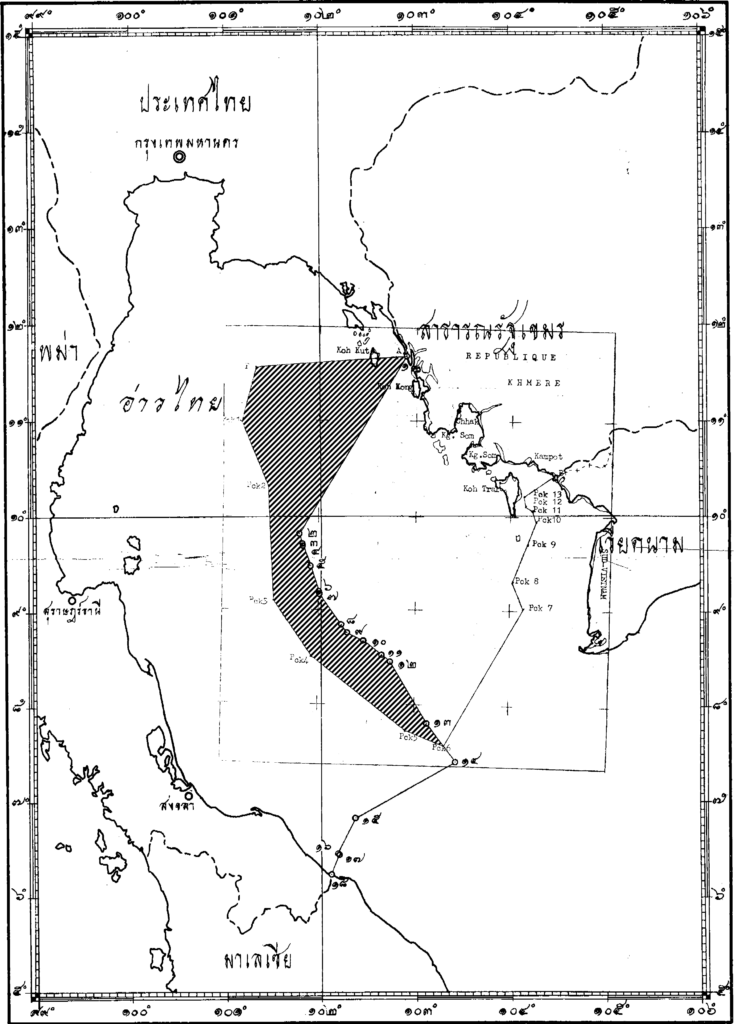
The overlapping claim area (OCA) in the Gulf of Thailand between the two countries dates back to when Cambodia and Thailand both claimed a continental shelf in 1972 and 1973 respectively pursuant to the 1958 Convention on the Continental Shelf in order to assert control over valuable seabed resources. The reason for the overlap lies in both geography and divergent interpretations on the international law on maritime boundary delimitation. The Gulf of Thailand is a semi-enclosed sea characterised by a complex coastal geography consisting of numerous offshore features. Both Thailand and Cambodia have taken fundamentally different approaches to their maritime claims, including different interpretations of the 1907 Franco-Siamese Treaty concerning the end point of their land boundary, the maritime entitlement of islands such as Koh Kut (located near the Cambodian coast but recognised by the 1907 Franco-Siamese Treaty as being under Thailand’s control) and the treatment of island basepoints in constructing their respective equidistance lines. Negotiations to resolve the issue reportedly started in the 1990s leading to the adoption of the 2001 MOU with the aim of agreeing ‘upon an early mutually acceptable basis for exploitation of the hydrocarbon resources of the [OCA] as soon as possible.’
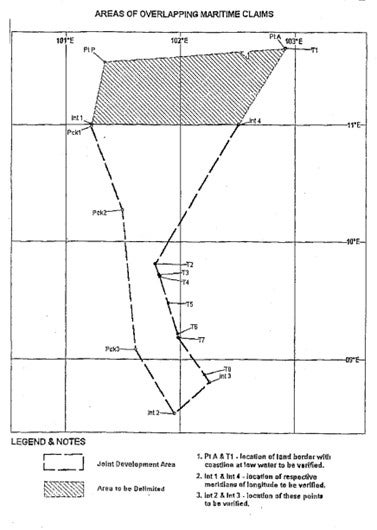
The 2001 MOU essentially divides the OCA into two blocs:
The map is attached to the 2001 MOU
The upper part (10,000 km2) is the ‘Area to be delimited’ (A2D) and the lower part (16,000 km2) is the ‘Joint Development Area’ (JDA). Notably, Article 2 of the 2001 MOU stipulates that it is the intention of the Parties to conclude an agreement for joint development in the JDA and a maritime delimitation in the A2D ‘simultaneously’ as ‘an indivisible package.’ In other words, the joint development treaty must be concluded at the same time as the maritime delimitation agreement. The 2001 MOU also established a Joint Technical Committee that is to meet regularly to discuss these issues. Since the signing of the 2001 MOU, however, progress has been stalled as the result of recurring political tensions between the countries: Thailand’s concerns that joint development may compromise their claims, and disagreement on approaches to the joint extraction of resources. Thailand reportedly cancelled the MOU as part of a policy review of a framework that had been in place for 25 years with no conclusion, stating that parties could rely on UNCLOS to guide future discussions.
Compulsory conciliation for maritime boundary disputes under UNCLOS Part XV
In the event that an agreement on the basis of international law cannot be reached within a reasonable period of time as stipulated in Articles 74 and 83 of UNCLOS, the states concerned may resort to UNCLOS Part XV dispute settlement mechanisms. Part XV allows states parties to unilaterally refer disputes on the interpretation or application of UNCLOS to binding adjudication or arbitration before international courts and ad hoc arbitral tribunals. However, in recognition that delimitation of maritime boundaries inherently involves politically sensitive issues related to sovereignty and sovereign rights over resources, Article 298 permits states to exclude disputes concerning the interpretation or application of Articles 15, 74 and 83 relating to sea boundary delimitation of the territorial sea, exclusive economic zone and continental shelf or those involving historic bays or titles from Part XV compulsory binding dispute settlement mechanisms. At the same time, as leaving the resolution of such disputes to negotiations also risks undermining peaceful relations, UNCLOS allows states to invoke compulsory conciliation for delimitation disputes if certain conditions are met.
Under Annex V of UNCLOS, the conciliation commission consists of five experts appointed by the parties which must hear the parties, examine their claims and objections, and make proposals to the parties with a view to reaching an amicable settlement. The commission issues a report, which records any agreements reached and failing agreement, its conclusions on all questions of fact or law relevant to the matter in dispute and recommendations facilitating an amicable settlement, within 12 months of its constitution. Although the report is not binding, the states concerned are required to negotiate an agreement on the basis of the report.
The Timor Sea Conciliation: possible implications for compulsory conciliation between Cambodia and Thailand
At the time of writing, Cambodia has not initiated compulsory conciliation, nor has it clarified the specific issues for conciliation. Nonetheless, the Timor Sea Conciliation has clarified some important issues on compulsory conciliation that have implications for any potential compulsory conciliation between Cambodia and Thailand.
First, a conciliation commission must satisfy itself that it has the competence to hear the dispute, including whether the conciliation meets the various conditions set out in UNCLOS. One critical condition is that the commission can only look at disputes that arise ‘subsequent to the entry into force of this Convention’ (Article 298(1) UNCLOS). In its decision on competence, the Timor Sea Commission clarified that the relevant date is 16 November 1994 – when UNCLOS entered into force as a whole rather than the date that the Convention became applicable between the parties in the conciliation.
In the case of Cambodia and Thailand, the existence of a dispute over the interpretation or application of Articles 15, 74 and 83 of UNCLOS that arose after 16 November 1994 is not straightforward. Under international law, the classic definition of a dispute is ‘a disagreement on a point of law or fact, a conflict of legal views or of interests’ between parties, which is a matter for objective determination. An assertion of a dispute is not sufficient, and it must be shown that the claim of one party is positively opposed by the other through, for example, official protests or an exchange of views. While Cambodia made its claim to its continental shelf in 1972 and Thailand in 1973, the mere existence of the OCA does not automatically amount to a ‘dispute.’ A determination of when the dispute arose between Thailand and Cambodia will depend on a range of factors, including the evidence adduced to show when one party positively opposed the claims of the other.
There may also be a question whether this dispute can be characterised as a dispute relating to Articles 74 and 83 of UNCLOS considering that the claims were made on the basis of the 1958 Continental Shelf Convention and UNCLOS negotiations were just starting. The Timor Sea Commission recognised that there was a distinction between a dispute which concerns the interpretation or application of UNCLOS and a dispute which invokes pre-existing rights and obligations from other sources and that a pre-existing dispute over maritime boundaries is not the same as a dispute over UNCLOS Articles 74 and 83. Accordingly, the commission’s competence over Thailand and Cambodia’s maritime boundary dispute will depend on an analysis of the legal basis and source of the respective claims of Thailand and Cambodia.
Second, another pertinent issue is the subject matter of the dispute submitted to the commission. Under Article 298, the scope of compulsory conciliation is limited to ‘disputes concerning the interpretation or application of articles 15, 74 and 83 relating to sea boundary delimitations or those involving historic bays or titles.’ The Timor Sea Commission found that Articles 74 and 83 also include the question of the transitional period pending a final determination and provisional arrangements of a practical nature in paragraph 3 of those articles and was therefore within its competence. As such, the Timor Sea Commission also addressed the need for a special regime of petroleum development in the Greater Sunrise area as it considered this was an integral part of reaching an agreement on maritime boundaries between Timor Leste and Australia.
Prima facie, Cambodia may also request that a commission consider provisional arrangements of a practical nature on the basis that this framework falls within the scope of Articles 74 and 83, in addition to the delimitation of boundaries. Indeed, the 2001 MOU specifically refers to provisional arrangements of a practical nature including a possible joint development treaty. Depending on how the dispute is characterized, it may even be further argued that a dispute over provisional arrangements of a practical nature arose much later when the 2001 MOU was terminated by Thailand, thereby meeting the requirement that a dispute on UNCLOS Articles 74 and 83 arose after 16 November 1994.
Compulsory conciliation as a valuable dispute settlement mechanism for maritime boundary disputes
It remains to be seen whether Cambodia will choose compulsory conciliation to settle the case with Thailand and whether a conciliation commission will decide it has the requisite competence. Moreover, it is not even guaranteed that compulsory conciliation will effectively resolve Thailand-Cambodia’s maritime dispute the same way it did in the Timor Leste-Australia dispute. The report of the commission is non-binding, and it is, ultimately, up to the parties to decide how and if they want to resolve the dispute. As put by Professor Tommy Koh ‘the most important factor, is that there was the political will on both sides to find a just and durable compromise. Both sides were willing to give and take. Without the requisite political will, the case would not have succeeded.’
Nonetheless, the potential invocation by Cambodia is a timely reminder on the value of conciliation (voluntary or compulsory) in the resolution of maritime boundary disputes. As demonstrated by the Timor Sea Conciliation, conciliation is a very different, and much more diplomatic process as compared to the adversarial nature of adjudication or arbitration with its often win-lose outcomes. Conciliation commissions can comprehensively engage with the parties to address the issues necessary to achieve an amicable and durable settlement and understand the various competing interests of both parties. The commission can go beyond legal factors to consider a wider range of factors including political and economic considerations and the recommendations may incorporate elements of equity if necessary. There is considerable flexibility in the outcome, and the conciliation report provides a framework for negotiations without necessarily being too prescriptive.
Undoubtedly, these developments have revived a long-standing source of tension between Thailand and Cambodia in an already turbulent time for the international order. However, while it is not clear what will happen in the future, it is reassuring that the public statements of these neighbours, who are also ASEAN member states, have reaffirmed the continued importance of UNCLOS as the applicable legal framework for the peaceful settlement of disputes between them.