

Remembering Peace in a Time of War: Why International Law Matters More Than Ever
Remembering Peace in a Time of War:
Why International Law Matters More Than Ever
by Nilüfer Oral and Rashmi Raman
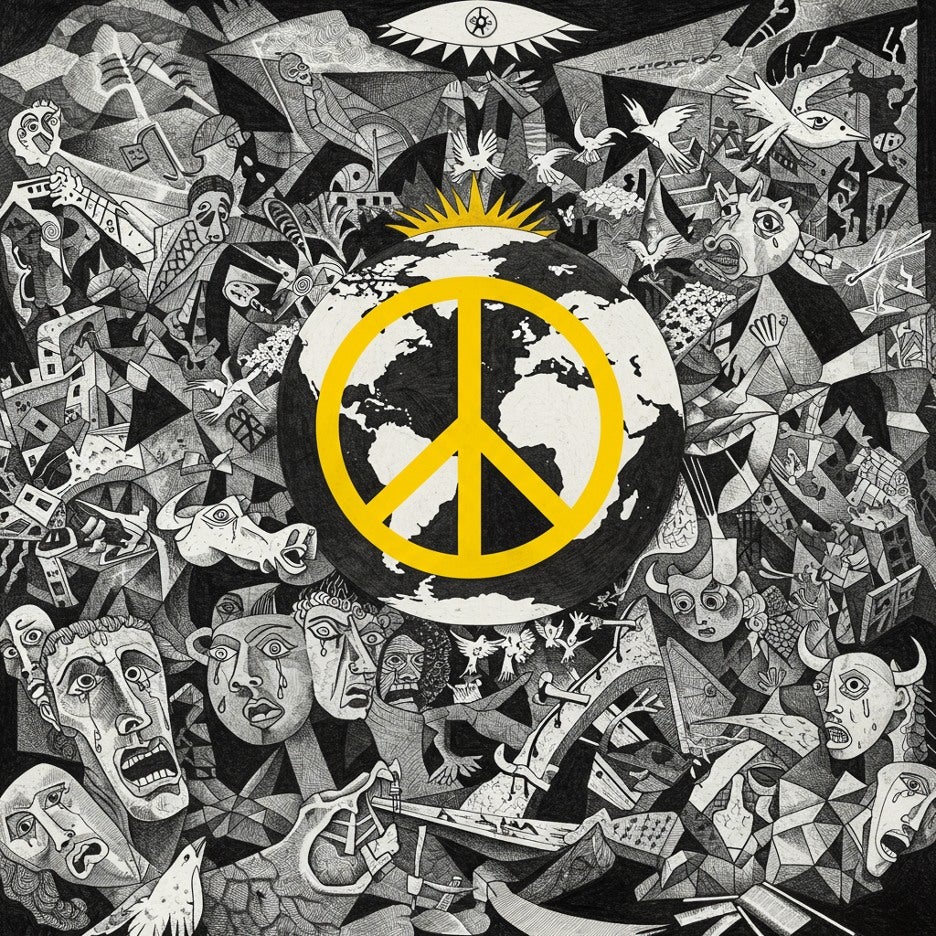
As the world watches missiles being hurled across the skies, bombs falling on hapless civilians, as the destruction of war becomes increasingly a common sight, it may seem odd to have a symposium on peace. Yet war, unfortunately, is more common than uncommon in the very long trajectory of human history. We can forget that in this same span of history, after war came peace and the challenge has been building a lasting peace.
History, mythology and their heroes are often recounted across the spectrum of wars and conquests and rarely through the narrative of peace. The history of the ancients, from the time of the Sumerians, Acadians, the ancient Persians and the Greeks, are tales of sacking and pillaging and cruelty. Grotius in his classic treatise on ‘war and peace’ wrote in the 17th Century:
‘The idea of peaceful equity among nations, now accepted as a human ideal, though still far from realisation, was for ages a difficult, if not an impossible, conception. All experience spoke against it, for war was the most familiar phenomenon of history.’
By contrast, little is written about the Kadesh Peace Treaty, the oldest known peace treaty, concluded between Hattusilli III, King of the Hittites, and Ramses, Pharaoh of the Egyptians in 1269 BC. The two empires were never to battle again, each side claiming victory. The bias towards war is also reflected in the lore of Genghis Khan, a name that conjures fear and images of marauding Mongols, was in fact a great lawmaker who brought long-lasting peace to the region we know as the silk road that traversed thousands of miles from Asia to Europe. It was under the laws (Yassa) of Genghis Khan that the Silk Road provided a safe passage for merchants, allowing for the free flow of goods and cultural exchange stretching across thousands of kilometers, a period that was known as the ‘Pax Mongolica’ and lasted during the 13th and 14th centuries.
Despite centuries of human history marked with the bloody and cruel imprints of war, remarkably, humans have also succeeded in bringing peace from the pyres of conflict, and not simply through signing of peace treaties, but by building long-lasting peaceful relations. Take the history of Europe, which was one of constant wars over territory and religion. Europe was the epicenter of the two most calamitous and inhumane wars in history. Yet from the colossal destruction of humanity emerged the European Union, described as the world’s largest peace project winning the Nobel Peace Prize. While it is a project that continues to face challenges, nonetheless, it stands as an example of how a seemingly endless history of conflict can be forged into peaceful and prosperous relations.
Paradoxically, the trade war the United States has unleashed against much of the world only exposes how deeply global stability has relied on cooperative trade agreements, whether under the WTO or through regional frameworks, which, despite their flaws, have largely upheld peaceful international relations. Ocean space, also an arena for conflict and disputes, is now regulated under one of the most impactful international treaties, the United Nations Convention for the Law of the Sea. Through compromise and cooperation, it created a framework which has brought peaceful order to the seas.
International law matters now more than ever for at least three compelling reasons. First, in an era marked by geopolitical instability, rising authoritarianism, and armed conflict, international institutions play an essential role in upholding legal accountability when states fail to honour their commitments to peace. These institutions provide a rules-based alternative to power politics, offering peaceful dispute resolution and reinforcing the idea that legal norms must constrain state behaviour. Second, as global crises, from climate change to pandemics, demand collective action, international law offers the only viable framework for coordinating state responses and ensuring that burdens and responsibilities are shared equitably. Finally, with growing scepticism toward multilateralism and a democratic deficit, international law functions as a safeguard for marginalised voices and human rights, anchoring a sense of global justice even when domestic systems falter. For us, reinforcing the legitimacy and effectiveness of international law as instrumental to peace is not just idealistic, it is urgent.
The current symposium will explore through the lens of different areas of international law how international law has created and promoted lasting peace. It is a reminder that from history’s worst wars, we have built institutions and legal frameworks under international law that have kept peaceful relations for decades. It is purposefully not taking a critical approach but rather reflective to start a discussion understanding the relationship between international law and peace through a multidimensional perspective. As the late Pope Francis said in his last public message, ‘peace is possible’.
This is the spirit of international law we aim to capture.
The Symposium is advocating for a shift away from conflict-centric narratives of international law to one that emphasises peace. It also launches the CIL-NUS Peace and International Law Project that will continue to (re)centre the language of international law within the vocabulary of peace. In this launch Symposium, we group our articles into three distinct but interrelated sets that we have defined as challenges to the framework that peace studies adopt under international law.
Manufacturing Peace is the first challenge we offer to the realist doctrines that cast peace as the antithesis of war. Echoes of this realism are to be found in post-conflict justice mechanisms, in the structure and grammar of international humanitarian law, human rights law and in the foundational ideas of international criminal justice. Overall, realist approaches to peacebuilding emphasise the importance of stability, security, and pragmatic diplomacy in international relations. Peacebuilding efforts, from a realist perspective, are primarily about managing conflicts and preventing war rather than pursuing long-term transformation based on idealistic principles. This analytical framework facilitates a reconceptualisation of peace as an active and multi-dimensional process rather than a mere absence of war. Writing within this general rubric, Samuel White and Rashmi Raman offer glimpses into alternative approaches to conflict resolution from Asia. Nilüfer Oral reflects on the historic moment on the creation of the UNCLOS as an instrument designed to bring peace to the oceans and its continuing relevance today. Elena Pribytkova’s piece on the right to peace in international law opens up an interesting line of conversation about having a justiciable human right to peace. Jon Truby’s piece on digital peace and the normative gaps in international law in this year of quantum forces us to reimagine the ‘invisible pillar’ for the UN Sustainable Development Goals.
In the second part of this Symposium, Building Peace, we offer a challenge to the deep seated institutional and legal structures that animate and inform international law on peacebuilding. The ‘international rules-based order’ approach to peacebuilding emphasises the importance of creating and upholding international rules, norms, and institutions to guide state behaviour and manage conflicts. This framework is rooted in the belief that global peace and stability are best achieved through multilateral cooperation, respect for international law, and the establishment of a predictable, stable, and just international system. Writing within this, Julia Vassileva reminds us of the silences within peace processes and comments on the role that international law must play in ensuring the participation, at all levels of the process, of women. Trisha Unnikrishna speaks of the actors outside of mainstream international law who are influential in the outcomes of peace processes. Onur Uraz’s examination of peace through the International Court of Justice invites us to consider whether the multiple Requests for Provisional Measures before the Court are helping or hindering the peace processes that are ongoing as the conflict(s) they seek Provisional Measures to stem, continue. Hla Yadanar Win’s comment on peace in the language of the Charter of the United Nations offers a pacifist re-reading of the powers of the Security Council using Article 24 to interpret Article 39 of the Charter.
Our third challenge in this Symposium, Brokering Peace, centres the treaties and diplomatic negotiations that create models of peace. We follow the constructivist model of peacebuilding in international law that the rules, norms, and identities that shape global governance are socially constructed, not fixed or determined by nature / history alone. It argues that the international legal system is not merely a set of objective rules but is influenced by social interactions, historical contexts, and shared understandings about justice, rights, and peace. The norms governing peace, justice, human rights, and sovereignty, for example, are the product of international communities’ shared understandings. Writing on these ideas, Wenlan Yang and Celine Lange examine the peace mandate that created and continue to animate two twin institutions that cohabit with the Peace Palace, with very different roles ascribed to them—the Permanent Court of Arbitration and the International Court of Justice. Hélène Tigroudja’s piece on the role that regional human rights courts play in creating a peace that holds, reconceptualises the power of institutions to deeply influence peace processes. Vincenzo Elia’s piece makes a case study of the once impossible idea of the integration of Europe and asks us to consider the creation, stability and continued strength of the European Union as a powerful narrative in brokering peace. Johan Pahlepi’s piece similarly, studies ASEAN as a deliberate intergovernmental commitment to ensuring lasting peace to build a stable and prosperous region.
Eighty years ago, the UN Charter was adopted. It is a compact for universal peace that arose out of the horrors of World War II. While there has been conflict during the past eight decades, there has also been much stability and development in many parts of the world, the foundation of which is in international law.
We are in one of those moments, inflection points, where it is important for international lawyers to speak out for the role that international law plays in creating, sustaining and repairing international peace and protecting it. Peace is fragile and sidelining peace as both a process and a product of international law risks centering conflict. Where there is much written and discussed about conflict and the abeyance of the international rule of law, we want to move the focus away from the all-consuming mechanisms, vocabulary and institutions of international law that have war and conflict as their foundation. Instead, we refocus the lens to create a thread of conversation among researchers in international law on the absolutely essential vocabulary of peace as a basis for “thickening” the international rule of law that informs, animates and protects states, from each other and from themselves, in the current landscape of the attack on international law and its institutions, actors and agents.