About the event
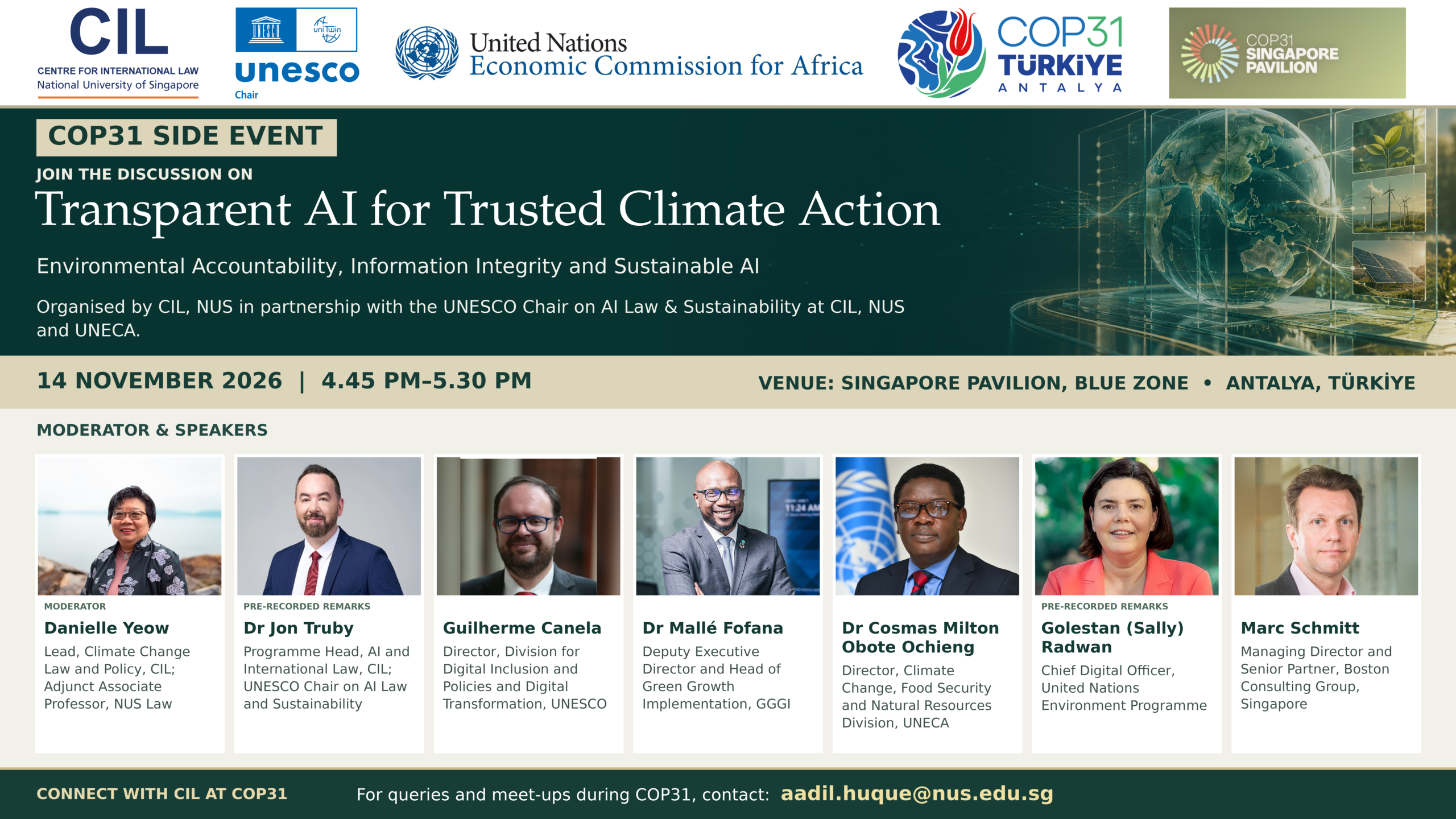
The Centre for International Law, National University of Singapore (CIL, NUS), in partnership with the UNESCO Chair on AI Law & Sustainability at CIL, NUS and the United Nations Economic Commission for Africa (UNECA), is organising a COP31 side event, ‘Transparent AI for Trusted Climate Action: Environmental Accountability, Information Integrity and Sustainable AI’, at the Singapore Pavilion in Antalya, Türkiye.
Artificial intelligence is increasingly used in climate modelling, energy systems, emissions accounting, adaptation planning and the assessment of environmental claims. These uses also raise questions about the energy, water and land impacts of AI systems, the accuracy of AI-generated climate information and the need to verify information used in climate policy, finance and carbon markets.
The discussion will bring together representatives of international organisations, academia and industry to consider environmental disclosure for AI, the provenance and verification of climate information and safeguards for the use of AI in climate-related decisions. It will consider how the Global Initiative for Information Integrity on Climate Change and the UN Secretary-General’s proposed AI Environmental Transparency Initiative can inform this work.
The event will introduce CIL’s consultation draft of a proposed Action Framework on AI Transparency and Climate Information Integrity. Participants and interested stakeholders are invited to provide comments and suggest revisions to the draft Action Framework. The consultation will inform further work on the framework towards COP32.
Connect with CIL at COP31
Colleagues and partners attending COP31 are welcome to join the discussion and meet with CIL on site. For event enquiries, meeting requests during COP31 or updates on the consultation process, please contact Sheikh Sultan Aadil Huque at aadil.huque@nus.edu.sg.
Moderator and speaker biographies
|
Danielle Yeow (Moderator) | Lead, Climate Change Law and Policy, Centre for International Law, NUS; Adjunct Associate Professor, NUS Law Danielle Yeow leads the Climate Change Law and Policy programme at the Centre for International Law (CIL), National University of Singapore. Her work covers public international law, international climate negotiations, cyber law and governance, international trade and investment, human rights and dispute settlement. She is also an Adjunct Associate Professor at NUS and teaches environmental and sustainability management law, governance and practice. She previously served as Deputy Director-General of the International Affairs Division of Singapore’s Attorney-General’s Chambers and Deputy Chief Executive of the Intellectual Property Office of Singapore. She has advised and represented the Singapore Government in international negotiations and proceedings, including negotiations under the UN Framework Convention on Climate Change and the Paris Agreement. She was an elected alternate member of the Paris Agreement Implementation and Compliance Committee from January 2020 to July 2021. Her earlier appointments include District Judge, Justices’ Law Clerk and criminal prosecutor. She holds an LLB from the University of Bristol and an LLM from the University of Cambridge and is admitted as an Advocate and Solicitor in Singapore and a Barrister in England and Wales. |
|
Dr Jon Truby (Speaker) Pre-recorded remarks | UNESCO Chair on AI Law & Sustainability and Programme Head, AI and International Law, Centre for International Law, NUS Dr Jon Truby is UNESCO Chair on Artificial Intelligence Law & Sustainability and Programme Head of AI and International Law at the Centre for International Law, National University of Singapore. As a Principal Research Fellow and formerly a visiting Research Associate Professor, his work examines the governance of AI, data and digital technologies, particularly their relationship with sustainability, international law and the United Nations Sustainable Development Goals. His research covers AI governance, digital decarbonisation and nature-positive technology policy, including applications of AI and data governance to climate action, anti-corruption, human rights and the rule of law. He chairs the International Law Association Committee on AI and Technology Law and participates in the OECD.AI Expert Group on AI Compute and Climate. He has also served on the UNESCO Group of Friends on the Ethics of AI and committees concerned with AI governance, data management and privacy. He was previously an Academic Visitor at the University of Oxford’s Institute for Ethics in AI and a Visiting Fellow researching AI law at Newcastle University Law School. Between 2010 and 2023, he was a member of the law faculty at Qatar University College of Law and served as a university research centre director. |
|
Guilherme Canela (Speaker) | Director, Division for Digital Inclusion and Policies and Digital Transformation, UNESCO; Secretary, Information for All Programme Guilherme Canela is Director of UNESCO’s Division for Digital Inclusion and Policies and Digital Transformation and Secretary of the Information for All Programme. Previously, he headed UNESCO’s Section for Freedom of Expression and Safety of Journalists at its Paris headquarters for five years. Before that, he spent eight years as the Communication and Information Regional Adviser for Latin America and the Caribbean at UNESCO’s Montevideo Office, where he coordinated work with judicial systems on democracy and freedom of expression. His work has included UNESCO programmes addressing disinformation, threats to human rights and the accountability of online platforms. These include Internet for Trust, the #CoronavirusFacts project, Social Media for Peace, Media and Elections and initiatives concerning the transparency of internet companies. From 2000 to 2008, he coordinated media and journalism research at the News Agency for Children’s Rights (ANDI), examining reporting on education, children’s rights, public health, violence and social development. He has co-authored ten books published by ANDI and contributed to research and policy discussions on media, human rights and access to information in Latin America. He holds a BA in International Relations from the University of Brasília and a master’s degree in Political Science from the University of São Paulo. |
|
Dr Mallé Fofana (Speaker) | Deputy Executive Director and Head of the Directorate for Green Growth Implementation, Global Green Growth Institute (GGGI) Dr Mallé Fofana is Deputy Executive Director and Head of the Directorate for Green Growth Implementation at the Global Green Growth Institute (GGGI). He has more than 22 years of experience in international development and the private sector, including resource mobilisation, project development and implementation. Since joining GGGI in 2018, he has served as Regional Director for Africa and subsequently Regional Director for Asia. His work has involved oversight of country programmes and collaboration with governments, businesses, multilateral development banks and investors to turn green growth policies into projects and investments. Before joining GGGI, he held managing director positions in management consulting firms and worked on economic and social development initiatives across Africa, Europe and the United States. His experience covers more than 100 projects in over 30 countries. He holds an MSc in Management, an MBA in International Development and a doctorate from the University of Lyon. |
|
Dr Cosmas Milton Obote Ochieng (Speaker) | Director, Climate Change, Food Security and Natural Resources Division, United Nations Economic Commission for Africa (UNECA) Dr Cosmas Milton Obote Ochieng is Director of the Climate Change, Food Security and Natural Resources Division at the United Nations Economic Commission for Africa (UNECA). His work spans environmental policy, international development, natural resource governance and research on equitable development. He previously led the Center for Equitable Development at the World Resources Institute and the African Natural Resources Centre at the African Development Bank. He has taught global development policy at Boston University and sustainable agriculture, land and water at Lancaster University. His earlier appointments include Executive Director of the African Centre for Technology Studies in Nairobi, coordinator of IUCN’s Business, Economics and Biodiversity programme in Eastern and Southern Africa and Research Fellow at the International Food Policy Research Institute. His research has been published in World Development, the Journal of International Economic Law and Natural Resources Forum. He holds a doctorate in Development Studies from the University of Oxford and a master’s degree in Development Studies from the University of Cambridge. |
|
Golestan (Sally) Radwan (Speaker) Pre-recorded remarks | Chief Digital Officer, United Nations Environment Programme (UNEP) Golestan (Sally) Radwan is Chief Digital Officer at the United Nations Environment Programme (UNEP) and a computer scientist specialising in artificial intelligence and emerging technologies. Her career combines public policy and international cooperation with senior roles in the technology sector. Before joining UNEP, she advised Egypt’s Minister of Communications and Information Technology and led the development and implementation of the country’s national AI strategy. She represented Egypt in discussions on AI policy and regulation involving UNESCO, WIPO, ITU and the OECD. She also led working groups within the African Union and the League of Arab States on regional approaches to responsible AI. Earlier in her career, she spent more than 17 years in technology executive roles in Germany, Austria, the United Kingdom and the United States, including at Novell, Avaya and NTT Data Europe. She holds a BSc in Computer Engineering from Cairo University, an MBA from London Business School and an MSc in Clinical Engineering and Healthcare Technology Management from City, University of London. |
|
Marc Schmitt (Speaker) | Managing Director and Senior Partner, Boston Consulting Group (BCG), Singapore Marc Schmitt is a Managing Director and Senior Partner at Boston Consulting Group in Southeast Asia. He leads BCG’s industrials work across social, climate and sustainability topics in the region. His work examines how long-term sustainability requirements and the energy transition are changing physical and financial markets, societies and economies across Southeast Asia. He works with corporate, public and philanthropic organisations. |