
Log In https://zoom.us/freesignup/ (if you do not have an account)
Join Zoom: https://zoom.us/join | Webinar ID: 880 9208 7294 | Passcode: No passcode for convenience
Click on Time Converter for the time in your location.

WEBINAR INTRODUCTION
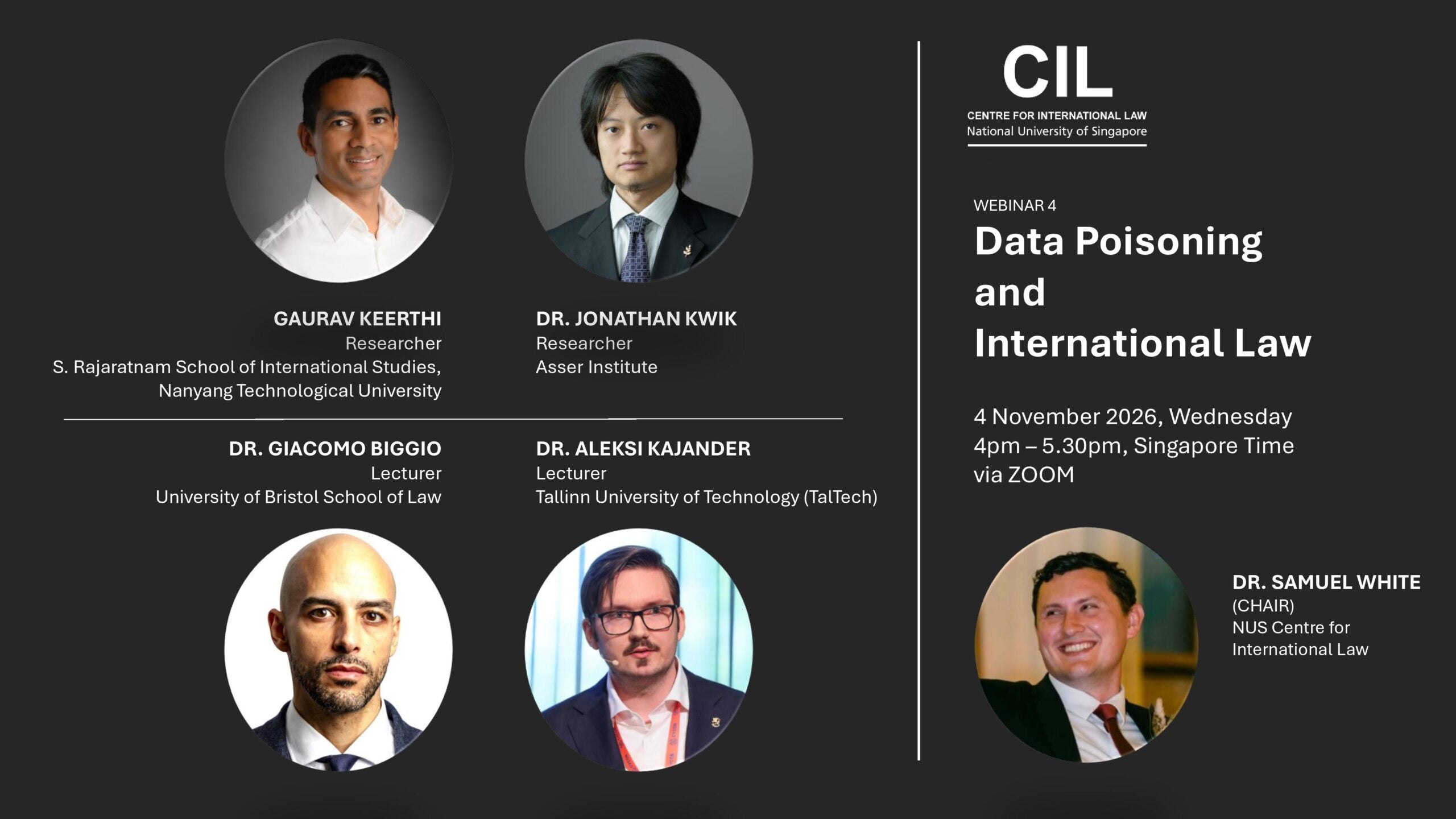
Artificial intelligence is only as reliable as the data it relies on. What happens when an adversary deliberately corrupts that data? Data poisoning involves manipulating the information used to train, inform or operate AI systems so that they produce misleading, unreliable or deliberately harmful outcomes. As militaries increasingly use AI for intelligence, surveillance, targeting, logistics and operational decision-making, manipulating data may offer a powerful way to disrupt an adversary without destroying a single computer or firing a weapon.
But where does international law draw the line? Could poisoning another State’s data amount to prohibited intervention or a use of force? During armed conflict, is manipulating an adversary’s AI a lawful form of deception — or could it constitute perfidy? When might interference with data qualify as an “attack” under international humanitarian law? And how do existing rules apply when one AI system is deliberately deceiving another? This CIL panel brings together experts in international law, cyber operations, cybersecurity policy and military AI to examine these emerging questions. Rather than assuming that new technology requires new law, the discussion asks how existing international legal rules apply when data itself becomes a weapon, a vulnerability and a battlefield.
PROFILES OF CHAIR AND PANELLISTS
Dr. Samuel White (Chair)
Samuel White is a Global Fellow at the Centre for International Law, and Scientia Senior Lecturer in Military Law and War Studies at The University of New South Wales (UNSW) Canberra.
Gaurav Keerthi
Gaurav Keerthi is founder and CEO of StrongKeep, delivering cybersecurity for smaller organisations. He was previously Deputy Chief Executive and Deputy Commissioner of Cybersecurity at the Cyber Security Agency of Singapore, where he led national cyber defence strategy and regulatory policy, and he served on Singapore's delegation to the UN Open-Ended Working Group on the security of ICTs. Before that he spent twenty-five years in the Republic of Singapore Air Force, retiring as a Brigadier-General and serving as its first CIO. He is an Adjunct Senior Fellow at RSIS, Nanyang Technological University.
Dr. Jonathan Kwik
Dr Jonathan Kwik is a researcher at the Asser Institute in The Hague, specialised in the law of armed conflict and emerging technologies. He is a member of the Drafting Team for the Manual on AI in Warfare, and a member of the Board of Experts of the Asia-Pacific Journal of International Humanitarian Law. He has written and theorised extensively on deception and countermeasures against military AI systems, and their legal ramifications. From January 2027, he will be lead researcher for the Lawful and Effective Defences against Military AI Project.
Dr. Giacomo Biggio
Dr. Giacomo Biggio is a Lecturer at the University of Bristol School of Law, where he teaches International Humanitarian Law, the law on the use of force, and International Human Rights Law. His expertise lies in International Humanitarian Law, with a focus on its application to cyberspace. His research has been featured in The Military Law and the Law of War Review, International Law Studies, The Journal of International Humanitarian Legal Studies, The Journal of International Peace and Armed Conflict, and The Journal of Conflict and Security Law. His publications have discussed issues such as the regulation of cyberweapons, the application of term ‘cyber-attack’ under International Humanitarian Law, and the legal status of hacker groups involved in the Russia-Ukraine armed conflict. He is a contributor to The Conversation, where he has written pieces on the armed conflict between Israel, Hamas and Hezbollah.
Dr. Aleksi Kajander
Dr. Aleksi Kajander is a lecturer at the Tallinn University of Technology. His work focuses on the interaction of international law and technology. He has written on the cybersecurity of weapon systems, the right to privacy during armed conflicts, and the regulation of autonomous weapon systems. Previously, he was a legal researcher at the NATO Cooperative Cyber Defence Center of Excellence, where besides conducting research, he contributed to the legal track of cyber exercises such as Locked Shields.
1.5 Public CPD Points
Practice Area: International Law
Training Category: General
Participants who wish to obtain CPD Points are reminded that they must comply strictly with the Attendance Policy set out in the CPD Guidelines. For this activity, this includes logging in at the start of the webinar and logging out at the conclusion of the webinar in the manner required by the organiser, and not being away from the entire activity for more than 15 minutes. Participants who do not comply with the Attendance Policy will not be able to obtain CPD Points for attending the activity. Please refer to http://www.sileCPDcentre.sg for more information.
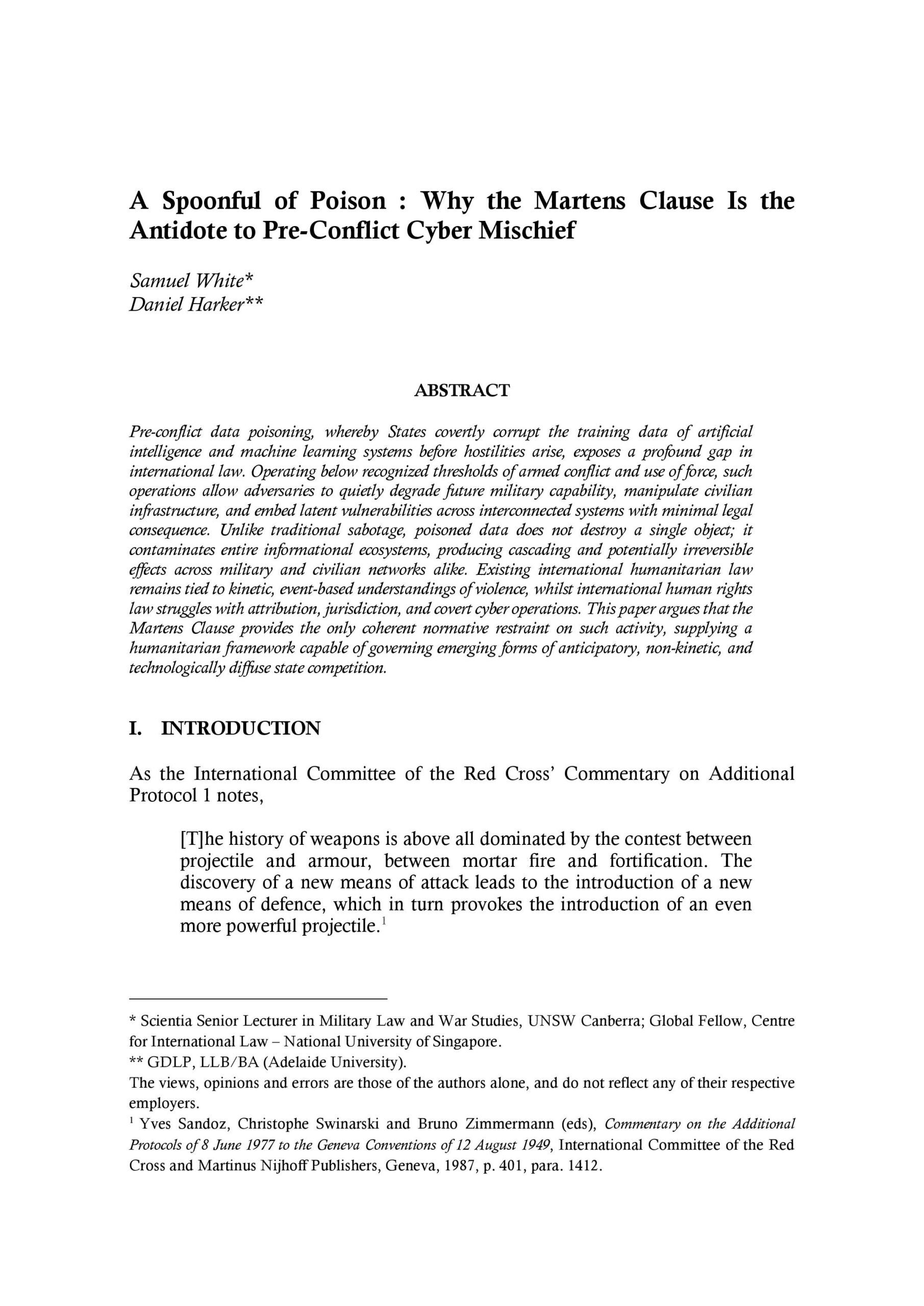
A Spoonful of Poison : Why the Martens Clause Is the Antidote to Pre-Conflict Cyber Mischief
Samuel White
2026, Asia Pacific Journal of International Humanitarian Law