
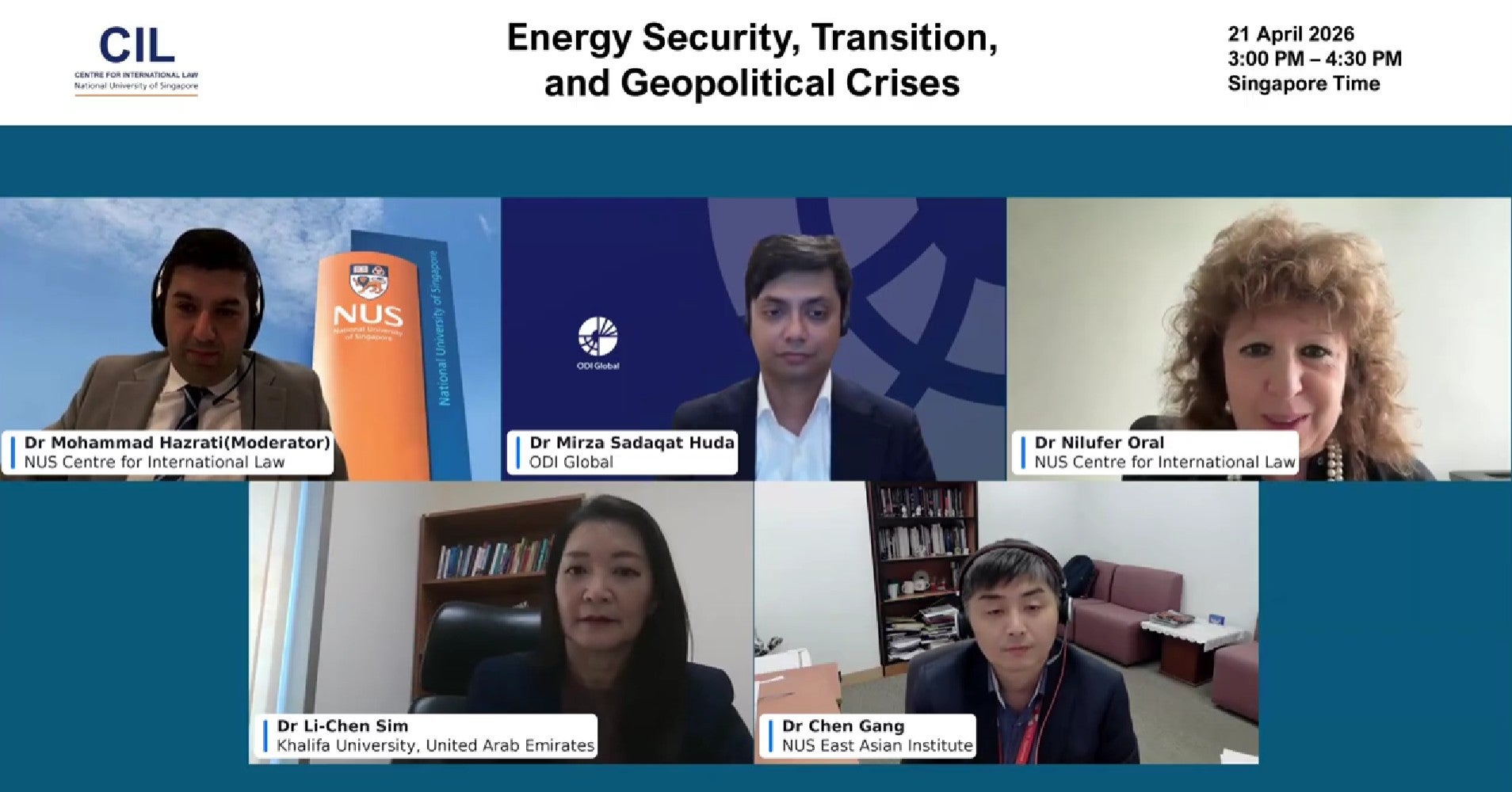
Click below image to view the recording
WEBINAR OVERVIEW
Ongoing geopolitical tensions in the Middle East have raised important questions about the stability of global energy systems. The Strait of Hormuz remains a critical transit route for oil and gas, and any disruption can have immediate effects on global supply, prices, and overall energy security.
This webinar will bring together different perspectives to examine how these developments may shape energy security and policy responses. It will begin by looking at the legal framework governing navigation through key energy routes, followed by a discussion of the broader energy security implications of current geopolitical uncertainty.
The webinar will also place these issues within the wider context of the energy transition, with a particular focus on Southeast Asia and China. As countries in the region continue to rely on energy imports while also pursuing climate goals, the discussion will explore how they are balancing short-term energy security concerns with long-term transition priorities.
PROGRAMME
3.00 pm Welcome Remarks
3.05 pm First Presentation by Nilufer Oral
3.20 pm Second Presentation by Mirza Sadaqat Huda
3.35 pm Third Presentation by Li-Chen Sim
3.50 pm Fourth Presentation by Chen Gang
4.05 pm Q&A Session
4.30 pm End of Webinar
PROFILES
Moderator
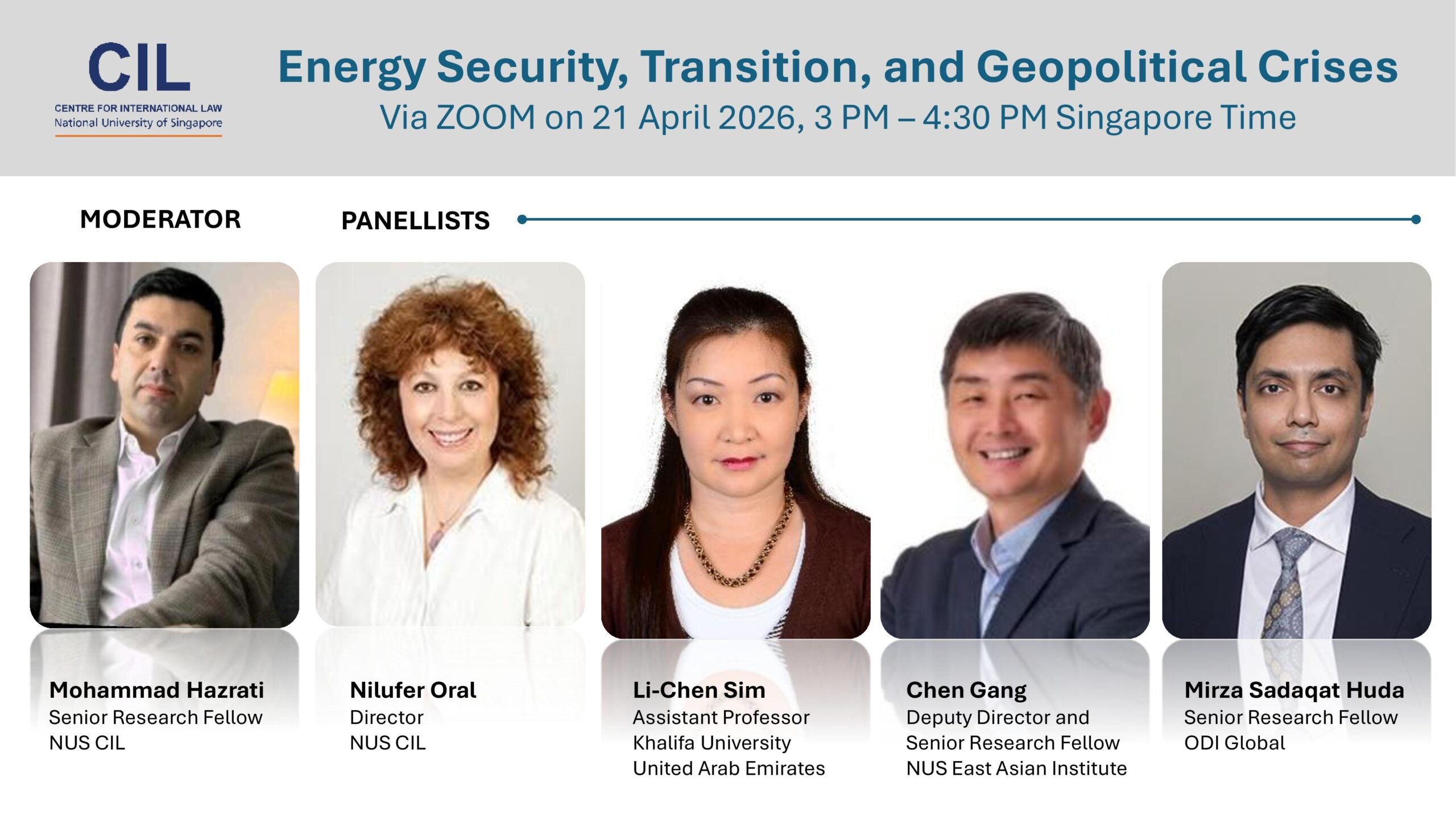
Mohammad Hazrati, Senior Research Fellow, NUS Centre for International Law
Dr Mohammad Hazrati is a Senior Research Fellow at the Centre for International Law (CIL), National University of Singapore (NUS), specialising in energy, environmental, and climate change law and policy, with a particular focus on the energy transition. Previously, he was a postdoctoral researcher at the Université de Pau et des Pays de l'Adour, France, working within the Energy Justice & Social Contract Chair, the Laboratory Energy and Environmental Transition (TREE), French National Centre for Scientific Research (CNRS). Dr. Hazrati holds a PhD in Energy Law from Queen Mary University of London (2020) and an MSc in Oil and Gas Law from the University of Reading, UK (2016). He has published extensively, including peer-reviewed articles, book chapters, and the book “The Rise of Restorative Justice in the Energy Transition and for Climate Mitigation” (Springer Nature).
Panellists
Nilufer Oral, Director, NUS Centre for International Law
Dr Nilufer Oral is Director of the Centre of International Law at the National University of Singapore. She is a member of the UN International Law Commission (ILC) and served as Chairperson of the 74th session of the ILC. She is a Co-chair of the ILC Study Group on sea-level rise in relation to international law. She is a Member of the Curatorium of The Hague Academy of International Law and is an associate member of the Institut de Droit International. She was a legal advisor and climate change negotiator for Turkish MFA (2009-2016). She is currently a Member of the Committee of Legal Experts of the Commission of Small Island States on Climate Change and International Law (COSIS). She served a member of Council of the International Union for Conservation of Nature (IUCN) and was Co-Chair of the Oceans Specialist Group of the World Commission of Environmental Law.
Li-Chen Sim, Assistant Professor, Khalifa University, United Arab Emirates
Dr Li-Chen Sim is an Assistant Professor at Khalifa University in the UAE. She holds a PhD in Politics from Oxford and is a specialist in the political economy of Gulf and Russian energy and its intersection with domestic politics as well as international relations. Her interests include the politics of energy in the Gulf, Gulf-Asia exchanges, and Russia-Gulf interactions. Her latest book is Low Carbon Energy in MENA (Palgrave, 2021).
Mirza Sadaqat Huda, Senior Research Fellow, ODI Global
Mirza is Senior Research Fellow in the Climate and Sustainability Programme and is based in Singapore. Mirza’s main areas of research expertise are regional electricity grids, critical minerals and just energy transitions. He is the lead author of the policy report ‘Accelerating the ASEAN Power Grid 2.0’, published by the ISEAS-Yusof Ishak Institute, which examines the challenges and opportunities of a regional electricity grid in Southeast Asia. He has also published reports on Southeast Asia’s critical mineral supply chains and just energy transitions in Indonesia and Vietnam.
Chen Gang, Deputy Director and Senior Research Fellow, NUS East Asian Institute
Dr Chen Gang is Deputy Director and Senior Research Fellow of the East Asian Institute (EAI), National University of Singapore. Since he joined the EAI in 2007, he has been tracing China’s politics, foreign policy, environmental and energy policies and publishing extensively on these issues. He is the single author of The Politics of Disaster Management in China: Institutions, Interest Groups, and Social Participation (New York: Palgrave Macmillan, 2016), China’s Climate Policy (London and New York: Routledge, 2012), Politics of China's Environmental Protection: Problems and Progress (Singapore: World Scientific, 2009) and The Kyoto Protocol and International Cooperation against Climate Change (in Chinese) (Beijing: Xinhua Press, 2008).