
As the first session in a broader series, this webinar will explore the foundational tensions that underpin the forthcoming volume Dual Use in Space (Springer), bringing together leading contributors to examine how legal frameworks are struggling to keep pace with technological convergence. Many of the capabilities that enable modern space activity, such as satellite constellations, remote sensing and on-orbit servicing, operate across both civilian and military domains. This creates persistent ambiguity around status, intent, and lawful use, particularly in periods of heightened geopolitical competition.
The discussion is likely to revolve around several core themes. One is the blurring of traditional legal categories, especially the distinction between peaceful and non-peaceful uses of outer space under instruments such as the Outer Space Treaty. Another is the question of how international humanitarian law applies in space, including issues of targeting, proportionality, and the protection of civilian space infrastructure that may be providing military support. A third theme is the role of commercial actors, whose assets are increasingly integrated into national security architectures, raising difficult questions about attribution, responsibility, and risk.
Attendees will leave with a clearer understanding of what “dual use” means in the space context and insight into where legal and policy debates are heading.
PROFILES OF MODERATOR, CHAIR AND PANELLISTS
Ayma Naseem (Moderator)
Ayma Naseem is a research associate at the National University of Singapore, Centre for International Law (CIL), where she contributes to projects exploring the role of artificial intelligence in military contexts and its implications for the environment. She earned her LLB (with first class honours) from the University of London and completed an LLM in International Law (with distinction) at the University of Edinburgh. During her time at Edinburgh Law School, Ayma served as Editor-in-Chief of the Contemporary Challenges Journal (CCJ).
Previously, she taught undergraduate law courses at the Islamabad School of Law and worked as a research associate at the National Assembly of Pakistan.
Samuel White (Chair)
Samuel White is a Global Fellow at the Centre for International Law, and Scientia Senior Lecturer in Military Law and War Studies at The University of New South Wales (UNSW) Canberra.
Andrew Sinclair
Andrew Sinclair is the Program Officer for Astrodynamics at the Air Force Office of Scientific Research (AFOSR). Before joining AFOSR, he worked at the Air Force Research Laboratory, Space Vehicles Directorate, and was on the faculty of the Aerospace Engineering department prior to that. He is a fellow of the American Astronautical Society and an Associate Fellow of the American Institute of Aeronautics and Astronautics.
Matthew Stubbs
Matthew Stubbs FAAL is a Professor and Academic Lead (Research Quality) at the School of Law, Adelaide University, where he serves as Editor in Chief of the Adelaide Law Review. Matthew’s teaching focusses on international law, human rights and public law, and has been recognised by three Australian national teaching awards. His research addresses the intersection of international and public law, with a particular focus on military law, space law and human rights, and has been published by numerous prestigious journals and book publishers.
Matthew is a member of the National Human Rights Committee of the Law Council of Australia and is a member and former Chair of the Human Rights Committee and Space Law Committee of the Law Society of South Australia. He was awarded the prestigious Law Society of South Australia President’s Medal in 2023 and was made a Fellow of the Australian Academy of Law in 2025.
Kristina Novakovic
Kristina Novakovic is an associate researcher at RAND Australia. Her research areas of expertise span the intersection of ethics, emerging technologies, and national security. Currently, she is focused on governance and ethics of AI, space technologies, and the rethinking extended nuclear deterrence in the Indo-Pacific, and examines these fields through the lens of normative ethics and organizational theory. She has a PhD from UNSW in International and Security Studies.
Ed Kruzins
Ed Kruzins is a Professor of Space Systems and Tracking at The University of New South Wales (UNSW) and leads research in asteroid science developing new scientific approaches to characterise resident space objects through the correlation of radar and optical data. He is a member of the National Council of Space Engineering, Honorary Fellow of CSIRO and Adj/Professor University of Adelaide. He is a past Director of the NASA/CSIRO Canberra Deep Space Communication Complex.
1.5 Public CPD Points
Practice Area: International Law
Training Category: General
Participants who wish to obtain CPD Points are reminded that they must comply strictly with the Attendance Policy set out in the CPD Guidelines. For this activity, this includes logging in at the start of the webinar and logging out at the conclusion of the webinar in the manner required by the organiser, and not being away from the entire activity for more than 15 minutes. Participants who do not comply with the Attendance Policy will not be able to obtain CPD Points for attending the activity. Please refer to http://www.sileCPDcentre.sg for more information.
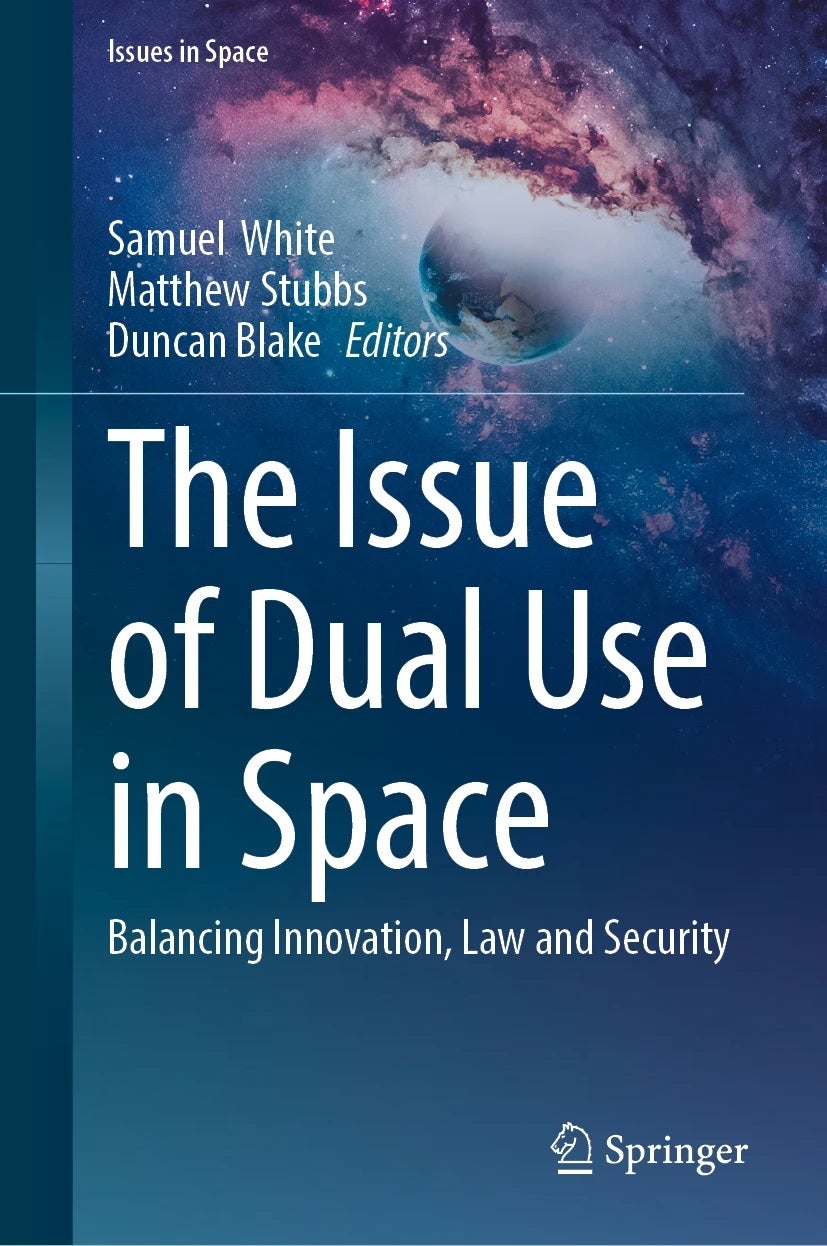
The Issue of Dual Use in Space
Balancing Innovation, Law and Security
- Book
- Aug 2026