

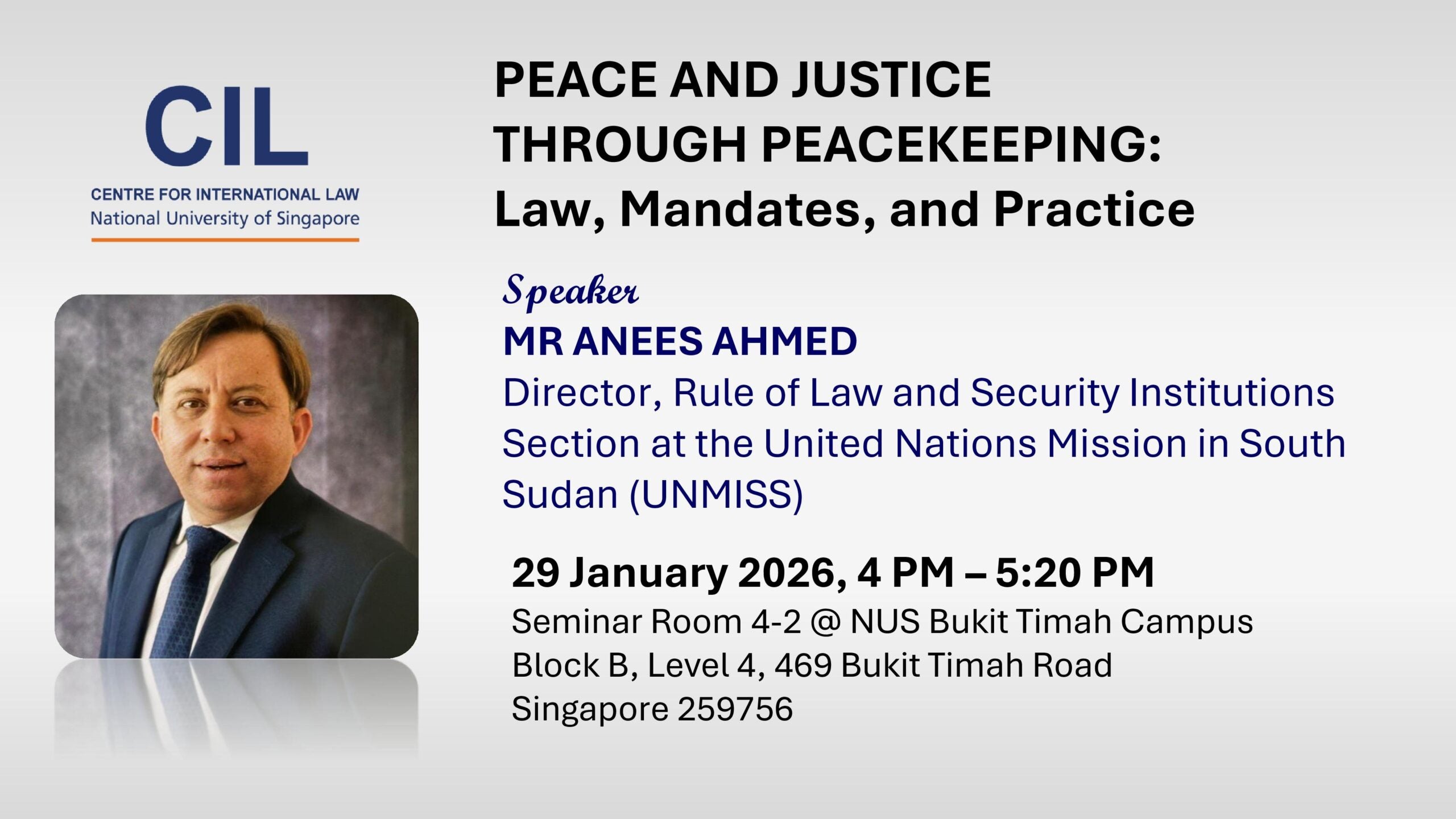
This lecture will be moderated by Rashmi Raman
Research Fellow, Centre for International Law, National University of Singapore
This lecture analyses how United Nations peacekeeping operations contribute to both peace and justice, focusing on how international law is operationalised through Security Council mandates, institutional cooperation, and field-level practice. Drawing on legal analysis and operational experience, the lecture will examine how legal norms shape professional advice, institutional decisions, and on-the-ground outcomes in complex environments.
A 30-minute segment of the lecture will be devoted to professional ethics and responsibilities of legal practitioners operating in high-risk advisory and institutional contexts. While examples are drawn from peacekeeping and mandate-based work, the focus of this segment is on ethical obligations and professional standards that arise in legal practice more broadly.
This lecture segment addresses the following ethics and professional standards relevant to legal practitioners.
First, values of the legal profession and ethical duties of lawyers. The lecture examines professional duties of integrity, independence, accountability, and candour, particularly where lawyers operate under institutional hierarchy, political pressure, or operational urgency.
Second, ethical judgment and professional responsibility in advisory roles. The lecture segment focuses on how lawyers are expected to exercise objective and principled judgment when legal advice carries significant consequences, including situations where ethical obligations require advice that may be inconvenient or unwelcome to clients or institutions.
Third, reputational risk management and professional conduct. The lecture considers how a lawyer’s conduct, advice, and decision-making affect institutional legitimacy, public trust, and the standing of the legal profession, and how ethical practice mitigates reputational and professional risk.
Fourth, ethics contextualized to legal practice. Although the examples arise from peacekeeping and international institutional settings, the ethical analysis is framed around general principles applicable to legal practice, including professional independence, role clarity, responsible client management, and ethical accountability.
 1.5 Public CPD Points (inclusive of 0.5 Public MEC Point)
REGISTRATION
Registration form closed at 11.30am, 29 Jan 2026. Walk-Ins are welcomed!