
Outer space has become an indispensable component of modern military, economic, and civilian life. Satellites support communications, navigation, weather forecasting, financial transactions, emergency response, and military operations, often simultaneously. This dual-use character presents significant legal and operational challenges during armed conflict. The targeting of space systems raises complex questions concerning military objectives, proportionality, precautions in attack, and the protection of civilian infrastructure upon which societies increasingly depend. This webinar examines the legal framework governing the targeting of dual-use space systems, the direct and indirect effects of attacks against them, and the practical challenges faced by military planners, legal advisers, and policymakers. Drawing on contemporary State practice and emerging scholarship, the discussion will explore how international humanitarian law applies in an increasingly contested space domain.
PROFILES OF CHAIR AND PANELLISTS
Samuel White (Chair)
Dr Samuel White is a Global Fellow at CIL, and the Scientia Senior Lecturer in Military Law and War Studies at UNSW Canberra, based within the Australian Defence Force Academy. He is an Editor at West Point’s Articles of War. Alongside his academic pursuits, Samuel has actively served as both a Royal Australian Infantry Corps and an Australian Army Legal Corps officer in a variety of tactical, operational and strategic level postings. He is a co-editor of a forthcoming volume on duality in the space domain to be published by Springer.
Clementine Rendle
As the ICRC’s Regional Legal Adviser in Bangkok, Clementine advises national authorities in Brunei, Cambodia, Japan, Lao PDR, Malaysia, Singapore, Thailand and Viet Nam on the adoption and implementation of international humanitarian law. She previously worked as the ICRC’s Regional Legal Adviser in the Pacific and with the Legal and Protection Divisions at ICRC Headquarters.
Clementine holds a Master of Laws in International Humanitarian Law and Human Rights from the Geneva Academy and a Graduate Certificate in the Law of the Sea from the University of Wollongong. She completed her Bachelor of Laws (Hons) and Bachelor of International Studies at the University of Sydney and is admitted to the High Court of Australia.
Duncan Blake
Duncan Blake is a lecturer in military and space law and strategy at UNSW Canberra. He is on the cusp of completing PhD research at Adelaide University on the intersection of space law and the laws of war - particularly on reconciling apparently conflicting legal rules. Duncan spent 22 years as a permanent RAAF Legal Officer, including several deployments to the Middle East. He initiated the projects that subsequently became MILAMOS and the Woomera Manual on the International Law of Military Space Activities and Operations, and had a role as Managing Editor throughout much of the Woomera Manual project. He is a co-editor of a forthcoming volume on duality in the space domain to be published by Springer.
Giacomo Biggio
Dr. Giacomo Biggio is a Lecturer at the University of Bristol School of Law, where he teaches International Humanitarian Law, the law on the use of force, and International Human Rights Law. His expertise lies in International Humanitarian Law, with a focus on its application to cyberspace. His research has been featured in The Military Law and the Law of War Review, International Law Studies, The Journal of International Humanitarian Legal Studies, The Journal of International Peace and Armed Conflict, and The Journal of Conflict and Security Law. His publications have discussed issues such as the regulation of cyberweapons, the application of term ‘cyber-attack’ under International Humanitarian Law, the legal status of hacker groups involved in the Russia-Ukraine armed conflict, and the application of Common Article 1 in the cyber domain. He is a contributor to The Conversation and Articles of War.
Christopher M. Bailey
Christopher Bailey currently serves as an Assistant Professor for the Department of Law and Director of the Law, Technology, and Warfare Research Cell at the United States Air Force Academy and currently serves as an active duty Judge Advocate in the United States Air Force. He has served in a range of legal counsel positions advising broadly on international law, cyber law, and space law and earned his Master of Laws degree in Space, Cyber, and Telecommunications Law from the University of Nebraska College of Law and his juris doctorate degree from the Illinois Institute of Technology’s Chicago-Kent College of Law.
1.5 Public CPD Points
Practice Area: International Law
Training Category: General
Participants who wish to obtain CPD Points are reminded that they must comply strictly with the Attendance Policy set out in the CPD Guidelines. For this activity, this includes logging in at the start of the webinar and logging out at the conclusion of the webinar in the manner required by the organiser, and not being away from the entire activity for more than 15 minutes. Participants who do not comply with the Attendance Policy will not be able to obtain CPD Points for attending the activity. Please refer to http://www.sileCPDcentre.sg for more information.
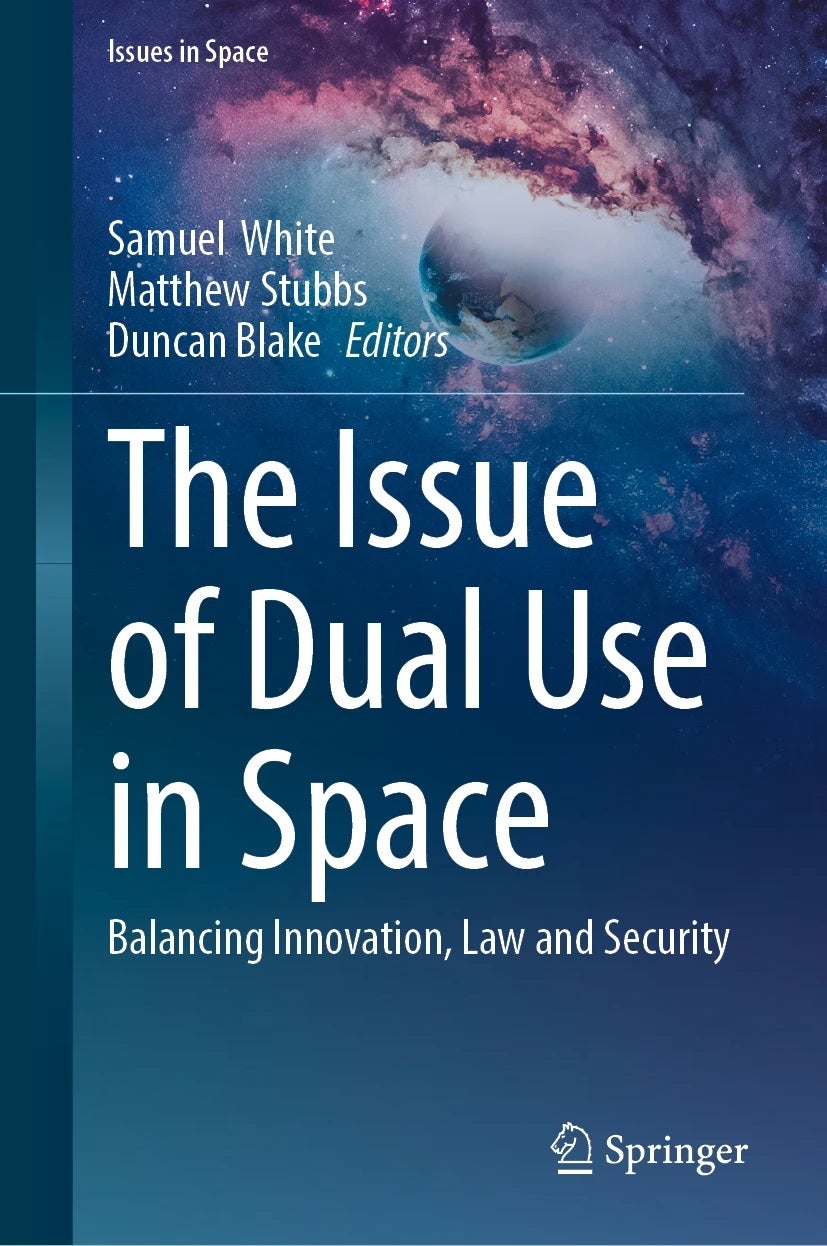
The Issue of Dual Use in Space
Balancing Innovation, Law and Security
- Book
- Aug 2026