

Enzo Elia participated in the three-day workshop “Debating Climate Litigation: Between Theory and Practice”
Enzo Elia presented his paper titled “Normative Causation in Climate Litigation: From Doctrine to Framework?” at the workshop “Debating Climate Litigation: Between Theory and Practice”, held at Erasmus University Rotterdam, The Netherlands.
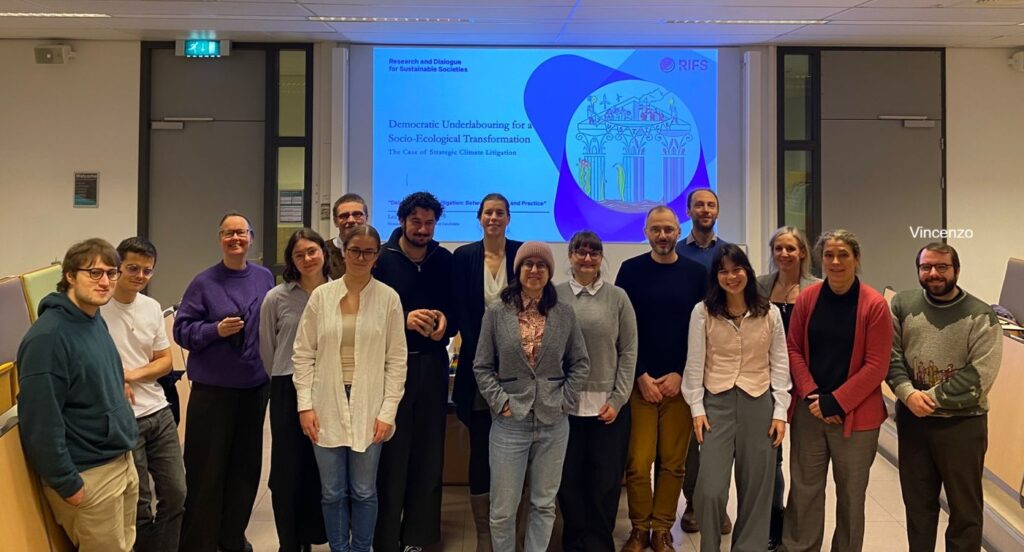
Enzo Elia participated in the three-day workshop “Debating Climate Litigation: Between Theory and Practice”, held at Erasmus University Rotterdam from 26 to 28 January.
His paper titled “Normative Causation in Climate Litigation: From Doctrine to Framework?” traced the emergence of “normative causation” across international law, human rights bodies, and international, regional, and domestic courts, showing how judges are shifting the focus from proving strict-but-for causation to asking whether states failed to take reasonable measures in light of foreseeable climate risks. He then proposed a composite framework that moves from the breach to the reparation stages to allocate responsibility while remaining within the rules of state responsibility (ARSIWA).
Abstract
Climate change litigation faces a persistent obstacle: how to establish that a particular state’s conduct has caused specific climate-related harm when countless actors contribute to a global, cumulative phenomenon. Traditional “factual causation” (the but-for test) and “legal causation” (the “sufficiently direct and certain link” standard) both prove inadequate in this context.
This paper argues that courts and tribunals are increasingly adopting what it terms normative causation – an approach that integrates risk-based reasoning, due diligence standards, and human rights obligations into the causal inquiry, thereby enabling liability determinations even where strict factual proof is unavailable.
Drawing on jurisprudence from the ECtHR, UN treaty bodies, domestic courts, and the ICJ’s 2025 Advisory Opinion on Climate Change, the paper identifies three key doctrinal innovations: (1) the rejection of the strict but-for test in favour of a “real possibility of mitigating harm” standard at the breach stage; (2) the use of cumulative/general causation to defeat the “drop in the ocean” defence; and (3) flexible, proportional approaches to reparation. The paper concludes by proposing a composite causation framework that courts could operationalise, distinguishing between the breach stage (where foreseeability and normative integration lower the threshold) and the reparation stage (where proportional attribution and flexible remedies address cumulative harm.