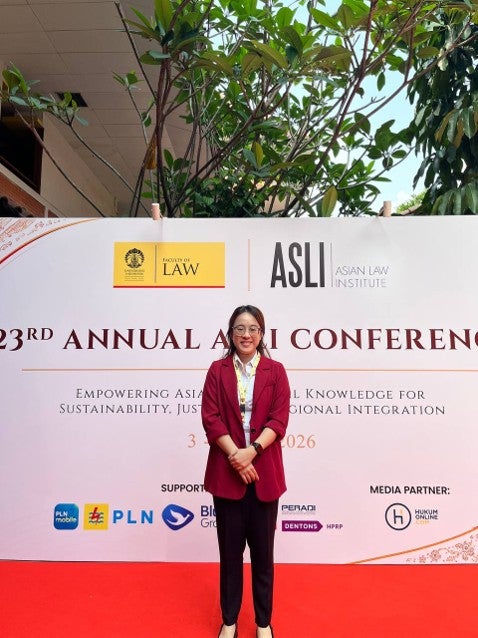

Yvette Foo presented her paper at 23rd ASLI Annual Conference 2026, Depok, Indonesia

Yvette Foo presented an updated version of her paper discussing the ASEAN Treaty on Extradition, which discusses ASEAN’s slow but steady commitment to transnational crime cooperation as a bloc, at the 23rd ASLI Annual Conference 2026.
The long-anticipated ASEAN Treaty on Extradition (ATE) was signed on 14 November 2025, marking ASEAN’s evolving approach to criminal justice cooperation from aspirational political commitments toward legally binding obligations. It aims to eliminate jurisdictional gaps historically exploited by fugitives, strengthen regional capacity to address transnational crime, and signal ASEAN’s commitment to the rule of law. Member states needed to adapt ASEAN’s norms and legal framework to overcome ASEAN’s well-established norms of sovereignty, non interference, and consensus-based decision making to adopt the ATE and advance extradition cooperation. Consequently, this paper presents a historiography of the numerous bilateral and multilateral arrangements, meetings, and relevant ASEAN instruments that prepared the region for a binding legal treaty on extradition. Adopting a doctrinal approach, and with reference to Acharya and Tan’s seminal works on ASEAN normative and legalisation work, it studies three decades-worth of cooperation, from the 1990s to 2005, 2005 to 2015, and 2015 to 2025: each representing a heightened level of confidence within the region to engage in extradition cooperation. In doing so, the paper situates the ATE as a compelling case-study evidencing ASEAN’s increasingly progressive, but still cautious, movement toward deeper security integration. Accordingly, the ATE presents a refreshing reminder that ASEAN’s socio-political infrastructure is not immutable to recognising new emerging trends and norms that pave the way for hard law commitments within the region.