
CIL Researchers Present at the 32nd ANZSIL Annual Conference in Canberra, Australia
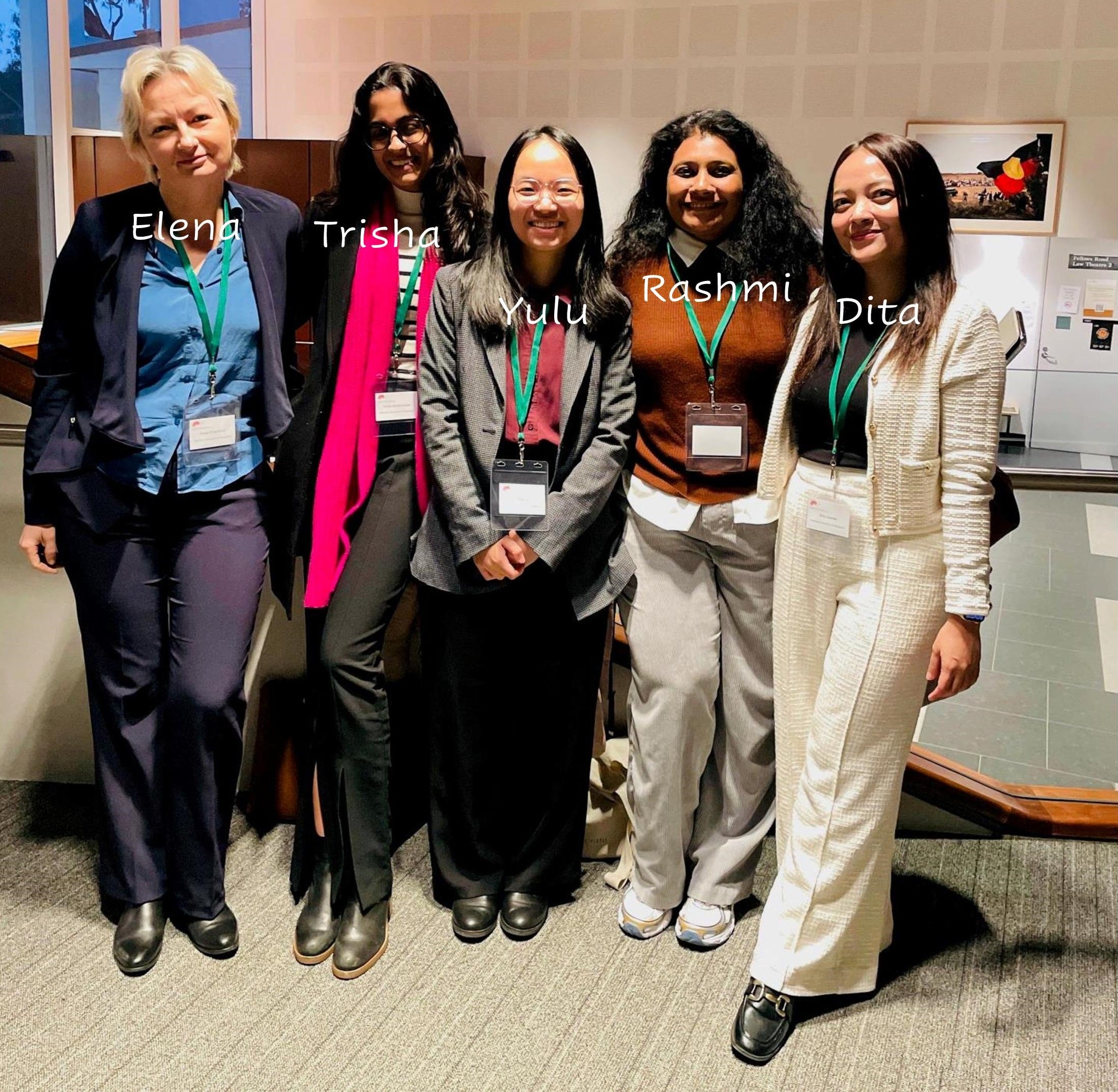

Five researchers from the Centre for International Law (CIL) presented their work at the 32nd Annual Conference of the Australian and New Zealand Society of International Law (ANZSIL), held from 2 to 4 July 2025 at the ANU College of Law in Canberra, Australia. Dita Liliansa and Yulu Liu from the Oceans Law and Policy team, along with Elena Pribytkova, Rashmi Raman, and Trisha Unnikrishnan from the Public International Law team, contributed to a range of panels across diverse areas of international law.
Dita Liliansa spoke on Panel I – Sea Change: Naval Warfare and the Margins of the Law. Her presentation, titled “Decolonising Naval Warfare Law: Can Small and Middle Powers Influence Its Evolution?”, examined the enduring influence of colonial-era structures on the law of naval warfare and questioned whether the current framework adequately reflects postcolonial geopolitical realities. Dita argued that while international law has evolved since the mid-20th century, the legal architecture of naval warfare continues to mirror Euro-American traditions, with limited contributions from formerly colonised states. This imbalance, she noted, is not only a historical legacy but a reflection of continuing power asymmetries in law-making and interpretation.
Elena Pribytkova presented on Panel 2 – Expanding Horizons: Human Rights, Global Justice, and Future Generations. Her presentation “Do We Have a Right to Global Assistance?” addressed a right to assistance in the realization of human rights and the achievement of Sustainable Development Goals. She demonstrated that discussions of this issue reflect an ideological rift between the so-called Global North and Global South. Even those developed states of the Global North, which recognize obligations to assist developing countries, explicitly assert that these obligations are not grounded in any “right” to assistance, but rather in global solidarity. Global South countries, on the contrary, insist on the legal recognition and institutionalization of the right to assistance and the corresponding obligations of the international community. Elena has suggested a new conception of the right to global assistance as a human right, which is conditional on individuals’ inability to enjoy the right to social support from their state and local non-state actors. She argued that current practices of state-centric international assistance, which are extremely insufficient, inefficient, often violate human rights and are used as tools of (neo-)colonial domination, must be substantially reshaped in light of the individuals’ right to assistance and be supplemented with instruments of person-centric global assistance. This presupposes three essential measures: (a) enabling marginalised individuals, as primary holders of the right to assistance, and their democratically represented communities to submit direct requests for global assistance; (b) ensuring poor individuals’ and communities’ participation in, and control over, the processes of seeking, receiving, and distributing international assistance that should be facilitated by states; and (c) fairly distributing obligations, corresponding to the right to global assistance, among all members of the international community.
Yulu Liu presented on Panel 7 – Hidden Harms: Environmental Accountability and the Politics of Omission. Her presentation, titled “Navigating the Governance Gap: Legal Pathways for Mitigating Greenhouse Gas (GHG) Emissions from Fishing Vessels,” examined current discussions about GHG emissions from fishing vessels, as well as the difficulties in regulating these emissions due to variations in vessel size, length, fishing patterns, and regional or national considerations. GHG emissions from fishing vessels are both an environmental issue and a matter that affects the livelihoods of millions of people, further adding to the complexity of the discussion.
Rashmi Raman presented on Panel 11 – Contested Lineages: Textbooks, Gender, and the Political Economy of Legal History.
Her presentation, “Representation as Disruption: Gender and the Invisible College of International Law”, argued that conceptualizing gender as reality, analysis, and rubric has fundamentally transformed and reshaped international law through processes of contestation, enquiry, and disruption. Drawing on feminist epistemologies, she highlighted how women and other non-male genders have increasingly asserted themselves as stakeholders, reclaiming spaces within international law that have long been dominated by a single gender. She emphasized that these feminist approaches are rooted in narratives of exclusion, violence, repression, and socio-culturally manufactured invisibility; contexts that have historically shaped the discipline.
Employing a TWAIL (Third World Approaches to International Law) methodology, she underscored the importance of intersectionality, arguing that it is grounded in identity and supports the broader feminist project of deconstruction. She described how this approach seeks to break down and challenge the very grammar and vocabulary with which international law is written, debated, and performed. Her paper critically examined the pervasive silences within the “theatres of performance” of international law, ultimately challenging the discipline’s composition as discordantly homogenous and insufficiently responsive to the complexities of our times. She maintained that unless feminist approaches are understood as disruptions to the normative and median biases of representation, the mainstream narrative of international law will continue to be characterized by entrenched patriarchal forms and biases.
Trisha Unnikrishnan presented on Panel 19 – The Missing Peace: Rethinking International Law’s Commitment to Peace and Security. Her presentation, titled “Buried in the Battlefield: Have we Forgotten about Peace in International Law?” explored the evolving role of international law in maintaining peace and security. It notes that the understanding of “force” under Article 2(4) of the UN Charter has expanded over time to cover a wide range of conduct that undermines the sovereignty of a State. Increasingly, actions involving non-State actors, occurring within the territory of a single State, or lacking physical damage are recognised as threats to international peace and security. However, this development remains inconsistent and is often driven by powerful States who frame certain crises as threats to peace and security. This influences the subsequent discourse on the issue and the measures sought in response, while further entrenching structural inequalities between States.