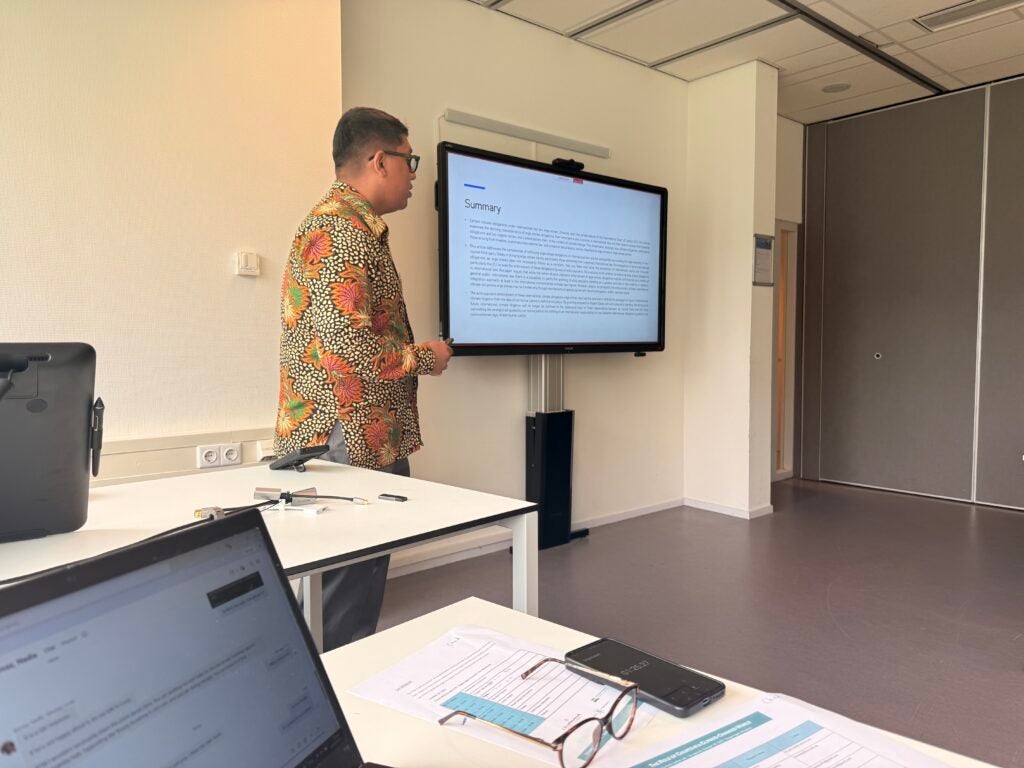

Conrado M. Cornelius presented “Actio Popularis Enforcement of Erga Omnes Climate Obligations and the Shift Towards Distributive Justice and Communitarianism in Future International Climate Litigation” at the 2nd Edition of the Climate Justice Lab
 Conrado M. Cornelius delivered a presentation titled “Actio Popularis Enforcement of Erga Omnes Climate Obligations and the Shift Towards Distributive Justice and Communitarianism in Future International Climate Litigation” at the 2nd Edition of the Climate Justice Lab with the theme “How Can Courts Shape Climate Justice Futures?” The Conference was held in Wageningen, the Netherlands, on 28 October 2025; hosted by the Wageningen University & Research (Law Group).
ABSTRACT:
In its recent Advisory Opinion on the Obligations of States with Respect to Climate Change, the International Court of Justice (ICJ) declared that climate obligations arising from both specific climate treaties and customary international law as erga omnes. This pronouncement implies that both injured and non-injured States may invoke State responsibility, by way of actio popularis standing, to ensure compliance with these obligations when breaches occur. Consequently, the enforcement of such non-bilateral erga omnes climate obligations offers an alternative to the orthodox bilateralist framework of State responsibility rooted in corrective justice. This paper advances the argument that prospective international climate litigation seeking to enforce erga omnes climate obligations will be guided by the communitarian logic of distributive justice, rather than corrective justice. By considering the international community interest as a whole, the enforcement of erga omnes climate obligations, especially by a non-injured State, is oriented at and always in the interest of another State, particularly the injured State, and never for itself. The enforcement of erga omnes obligations is, therefore, a matter of justice, particularly distributive justice. Such an enforcement can be seen as a mechanism through which the international community, as a subject of international law represented by the claimant non-injured State as its agent, ensures that all States are given the right to reparations when injured and that they comply with their obligations, particularly those with erga omnes characteristics, under international law.