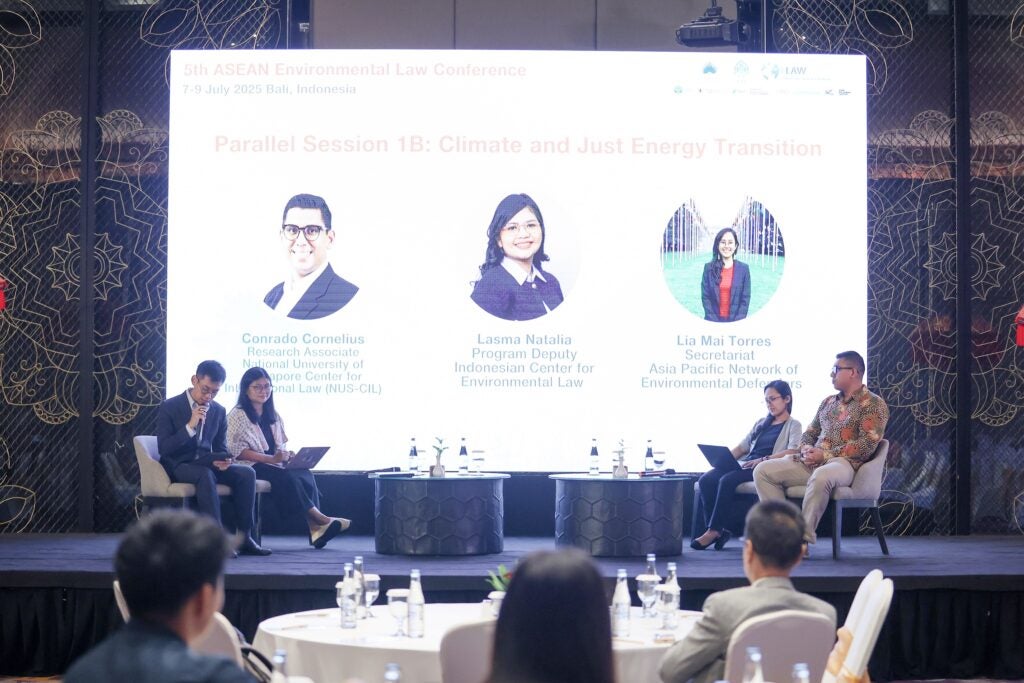

Conrado M. Cornelius presented at the 5th ASEAN Environmental Law Conference
categories: Public International Law

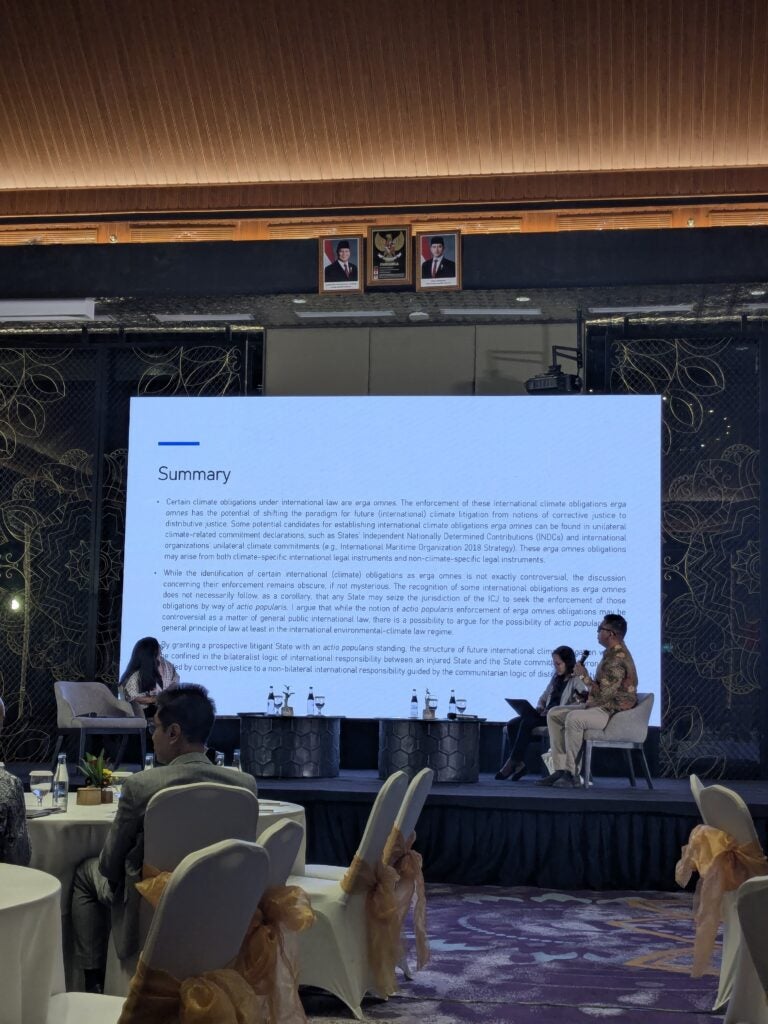
Conrado M. Cornelius delivered a presentation titled “Conceptualizing International Climate Obligations Erga Omnes” at the 5th ASEAN Environmental Law Conference with the theme “Advancing Regional Commitments for Environmental Justice through Legal Approaches.” The Conference was held in Bali, Indonesia, from 7-9 July 2025; co-convened by three collaborating institutions Asian Research Institute for Environmental Law (ARIEL), Indonesian Center for Environmental Law (ICEL), and Environmental Law Alliance Worldwide (ELAW).
ABSTRACT:
Conceptualizing International Climate Obligations Erga Omnes
- Certain climate obligations under international law are erga omnes. The enforcement of these international climate obligations erga omnes has the potential of shifting the paradigm for future (international) climate litigation from notions of corrective justice to distributive justice. Some potential candidates for establishing international climate obligations erga omnes can be found in unilateral climate-related commitment declarations, such as States’ Independent Nationally Determined Contributions (INDCs) and international organizations’ unilateral climate commitments (e.g., International Maritime Organization 2018 Strategy). These erga omnes obligations may arise from both climate-specific international legal instruments and non-climate-specific legal instruments.
- While the identification of certain international (climate) obligations as erga omnes is not exactly controversial, the discussion concerning their enforcement remains obscure, if not mysterious. The recognition of some international obligations as erga omnes does not necessarily follow, as a corollary, that any State may seize the jurisdiction of the International Court of Justice (ICJ) to seek the enforcement of those obligations by way of actio popularis. I argue that while the notion of actio popularis enforcement of erga omnes obligations may be controversial as a matter of general public international law, there is a possibility to argue for the possibility of actio popularis as a general principle of law at least in the international environmental-climate law regime.
- By granting a prospective litigant State an actio popularis standing, the structure of future international climate litigation will not be confined in the bilateralist logic of international responsibility between an injured State and the State committing the wrongful act guided by corrective justice to a non- bilateral international responsibility guided by the communitarian logic of distributive justice.