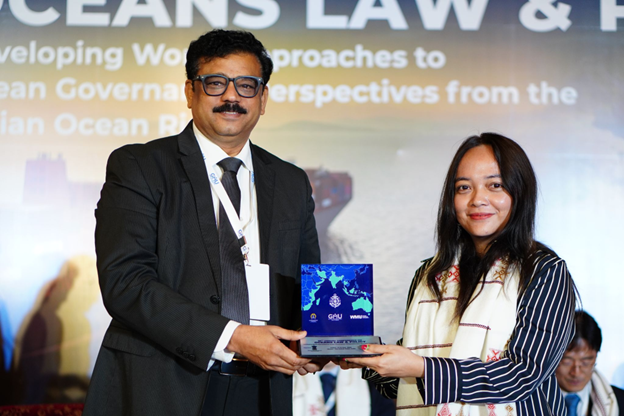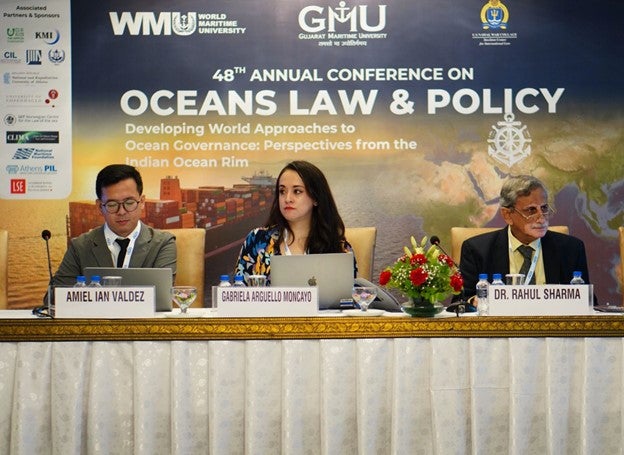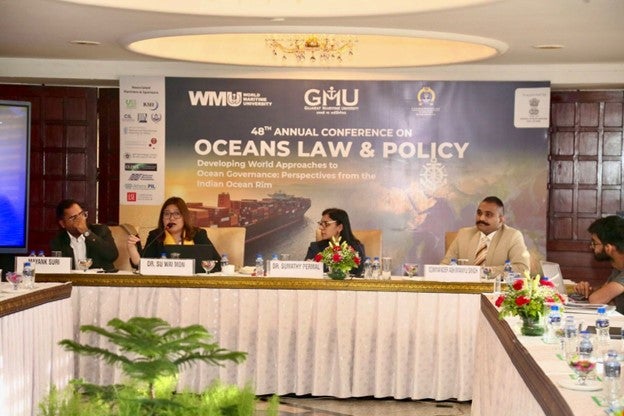
Dita Liliansa, Amiel Ian Valdez, and Su Wai Mon presented their respective research projects at the 48th Annual Conference on Oceans Law and Policy (COLP) in New Delhi, India
CIL Researchers - Dita Liliansa, Amiel Ian Valdez, and Su Wai Mon - shared and presented their current research works at the recently concluded 48th Annual Conference on Oceans Law and Policy (COLP48), which was held in New Delhi, India from 9 to 11 September 2025.
The conference revolved around the theme ‘Developing World Approaches to Ocean Governance: Perspectives from the Indian Ocean Rim’. It was jointly organized by Gujarat Maritime University, World Maritime University (WMU) Sasakawa Global Ocean Institute, and US Naval War College Stockton Center for International Law, and co-sponsored by 12 other institutions, one of which was the NUS Centre for International Law. The dialogues and deliberations were divided into the following sessions and panels:
- Tackling the Triple Planetary Crisis in the Indian Ocean: Biodiversity, Climate Change, & Pollution
- Special Interest of the Small Island Developing States (SIDS) in the Indian Ocean Region
- International Trade and Shipping
- Regime Interactions and Role of Non-State Actors
- Offshore Oil and Gas and Critical Infrastructure
- Ratification and Implementation of the BBNJ Agreement
- Autonomous Shipping
- Seabed Mineral Mining
- Maritime Security
- Emerging Technologies and Artificial Intelligence in the Oceans
- Fisheries and Food Security
- Maritime Boundaries and International Dispute Settlement
- Future Ocean Governance in the Indian Ocean
Dita joined the panel on ‘Maritime Security’ where she presented her work on ASEAN cooperation in maritime security. Her panel examined critical regional security concerns on military exercises, human trafficking, migrant smuggling, piracy, and other security issues in the Indian Ocean.
Amiel joined the panel on deep seabed mining where he presented his paper titled ‘Re-examining the Legal Standards of Precautionary Principle and Environmental Impact Assessment in the Context of the Deep Seabed Mining in the Area’. This panel explored the scientific evidence behind seabed mining, economic values of the mineral and there is a growing interest in them, recent developments in the International Seabed Authority Mining Code negotiations, among others.
Su joined the panel on Autonomous Shipping, where she highlighted the critical importance of cybersecurity for the future of autonomous vessels. She explored real-world risk scenarios of cyber threats to the maritime domain addressing their potential impacts on national security, the marine environment, and the global supply chain, with far-reaching consequences for the world economy. Su also shared recent cases of cyber-attacks on ships and ports, emphasizing the need for a proactive and collaborative approach to cybersecurity. As the industry moves toward autonomous shipping, reliant on AI, IoT, machine learning, and other advanced technologies, she recommended that cybersecurity must remain a top priority to ensure the safety and security of autonomous shipping. (Click here for Su's presentation)
COLP48 brought together both in-person and online participants and speakers from across the globe. The discussions were enriched by the wide-ranging perspectives from the speakers who are judges from international tribunals, academics, scholars, law students, naval officers, diplomats, and practitioners.